New Heart, New Me?

Identity is such a strange thing. I’ve spent so much of my life trying to figure out mine. Where do I fit? Who do I “go” with? Who am I? What is my place in the world?

Identity isn’t simple. No one is just one thing. We are many things to many people, and we are many things to ourselves. Some pieces are bigger than others. There are parts of our identity that are more comfortable to sit in, that feel more authentic than others.

And right now, I am struggling a little because a big part of my identity has changed. A big part of who I am is different now.

Today, my mom asked, “Do you still have congenital heart disease?”

And I guess the answer is no. But also, both.

CHD is who I was. It is part of how I was born. It brought me struggles and growth; it gave me a community and set me apart. Now I am a heart transplant recipient. Everything is new. A new community, new struggles, new places to grow, new ways to be set apart. A whole new identity. A whole new playbook.

But just because I am now a transplant recipient doesn’t mean I am no longer part of the CHD community. I spent 44 years with a CHD heart and all that entails. CHD was boot camp. It prepared me for transplant life. It taught me everything I know about managing complex medical issues. It shaped my personality, my outlook—my whole life, really.

And though I know my CHD life will always be part of me, there is grief in knowing that, in many ways, that part of my life is over.

I took a lot of pride in living with something that was truly difficult, and in never knowing any different. There was pride in pushing through every difficult day in pursuit of as much normal as I could get, for as long as I could get it.

Moving forward with transplant evaluation and listing was incredibly challenging because I knew it was the first step away from my CHD identity. In a lot of ways, it felt like a betrayal of the kid who fought through it all, even when it was scary.

Laugh if you want, but transplant felt, in a lot of ways, like the “easy” way out.

As a kid, I didn’t really know how to BE a kid with CHD, so a lot of the time, I just wasn’t. I didn’t talk about it much (unless I was in gym class), and when someone asked about my scars, I more than once gave a crazy answer like, “I fell on an axe.”

How does a second grader explain complex congenital heart disease to another second grader?

They don’t.

They tell them they fell on an axe and hope someone changes the subject.

I didn’t want to be seen as different, and I think a lot of the time I succeeded. I didn’t do sports, and I made sure I didn’t give people many chances to spot the differences.

In my teens, the cracks started to show. Things changed as my body changed, and soon enough I was symptomatic and spending my summers in hospitals, getting treatments and having procedures to stabilize heart rhythm issues. There were new limits, new meds, new scars, and, if I am honest, a new chip on my shoulder about this long-dormant issue that was rearing its head.

The hardest part of that time was not knowing ANYONE like me and truly believing I was not long for the world.

I had no proof that life was possible. And if I’m honest, a lot of the doctors I saw weren’t super helpful in dissuading that belief. Many talked about how amazing it was that I was still alive at all. Others wanted to try experimental surgeries that had never succeeded but, according to them, the deaths weren’t a result of the surgery.

I may have told one doctor, “Unless they were all hit by trucks, I think the surgery had something to do with it.”

I do stand by that, but perhaps it was sharper than it needed to be.

I give that scared teenager some grace, and I hope that doctor didn’t take my words to heart. I am friends with more than one cardiologist these days, and I can’t imagine anyone saying that kind of thing to one of them.

And I know those cardiologists because I longed so desperately for a community I could relate to.

As a young adult, I went looking for one and found a local support group. There I met a man named Jason. He and I got on like a house on fire, and one day he told me about a camp in St. Louis for kids with congenital heart disease.

As it happened, I was out of work and had the time to go, so we sent in applications, not knowing how much the camp needed—and wanted—the help of adults with CHD.

Sadly, before we could make the trip together, Jason died suddenly from complications of his CHD.

I was crushed.

My first friend in the CHD community, and this is what happened?

Perhaps seeking out this particular community had been a bad idea. After all, I was looking for hope that I would live, not confirmation that I could die.

When I called Becca, the camp director, to tell her Jason had passed and that she would need to fill two counselor spots, she encouraged me to come anyway. I think she sensed my deep grief and knew I was ready to walk away from a community she understood could be incredibly impactful for me.

I agreed to go, but the whole way there I considered turning around. Even after I arrived, there were moments when I thought about leaving before the kids showed up.

But Becca and the whole staff made sure I felt welcome. They gave me a lot of love and encouragement. And by the end of camp—camp working how it does—I had a whole new family in the CHD community: kids, adults, doctors, nurses, and other specialists who were entrenched in this world I hadn’t even really known existed.

There are more kids with transplants who go to camp than I can count, and they are still considered CHD kids.

So I suppose I am too.

Maybe I just have a new addendum at the end:

Congenital Heart Disease, D-TGA, VSD, ASD, post-transplant.

That seems right.

So, do I still have congenital heart disease?

Maybe “have” isn’t quite the right word anymore. But 44 years of CHD didn’t disappear when my old heart did. It is in the kid who learned how to hide her differences, the teenager who wondered whether she had a future, the scared young adult who went looking for people like her, and the community that eventually became family.

Now there is another piece to add.

My identity, like everyone’s, is still evolving. There will probably be days when it feels clear and days when it feels convoluted. I’m still figuring out what it means to be a transplant recipient and how that new identity fits alongside everything that came before it.

Maybe I haven’t left my CHD identity behind.

Maybe I just added another comma.

Maybe I am just a little more.
CHD Awareness?

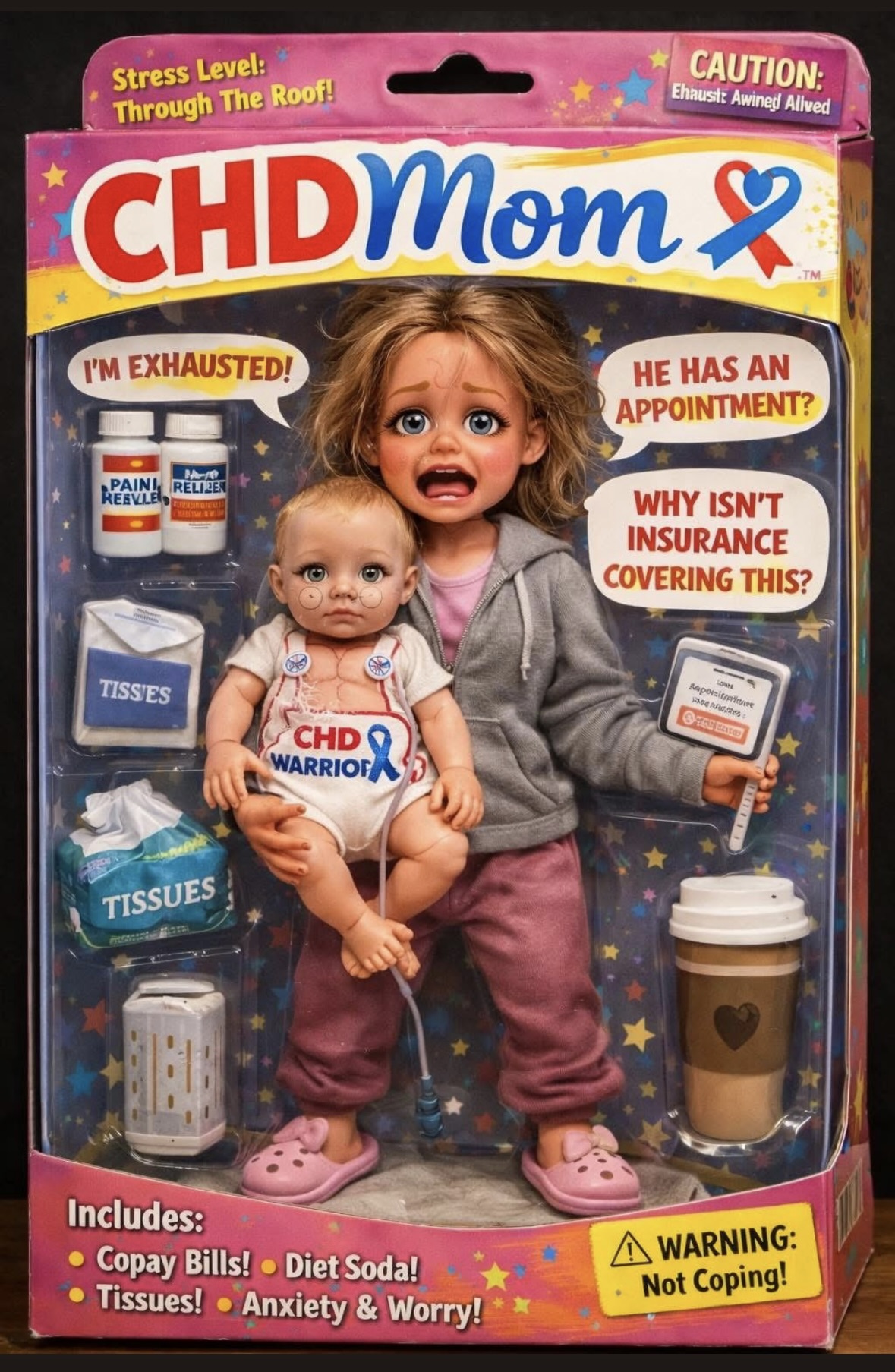
Last night, while scrolling, I stumbled across a set of images about congenital heart disease. I was not looking for them. They simply appeared. And if I am really honest, they were about the last thing I needed to see after a day of watching appointment after appointment populate my hospital’s patient portal, while also grappling with the heavy emotions of transplant evaluation, again.

What surprised me most was how upsetting they were, even now, even after decades of living with congenital heart disease as an adult. I still carry a familiar tension. I need support, and I also worry deeply about asking for too much of the people who love me. Those two things have always lived side by side in my body. Seeing these images brought that conflict straight to the surface.

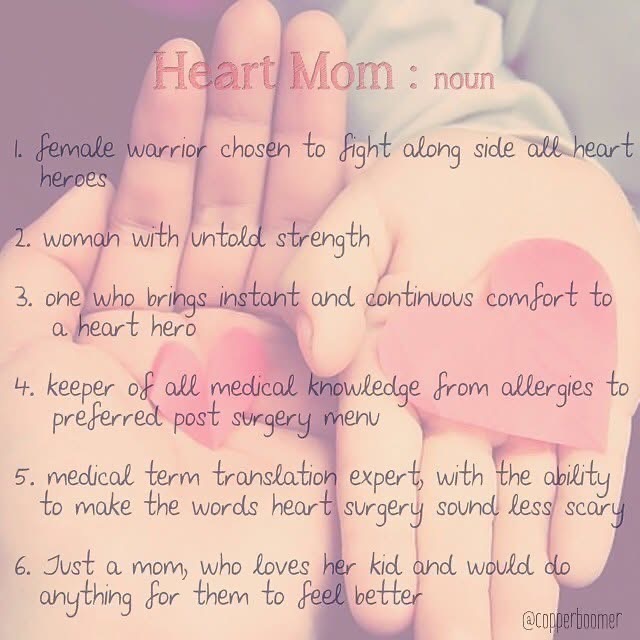
I want to be clear about why images like these are damaging, and about the difference between what a “heart mom” or “heart dad” might see, versus what a person living with CHD sees.

I am a 43-year-old adult living with congenital heart disease. I grew up as the child everyone worried about, planned around, and tried to protect. Children with CHD learn very early to read the room. We learn to track tone, tension, and fear long before we have language for what is happening inside our own bodies.

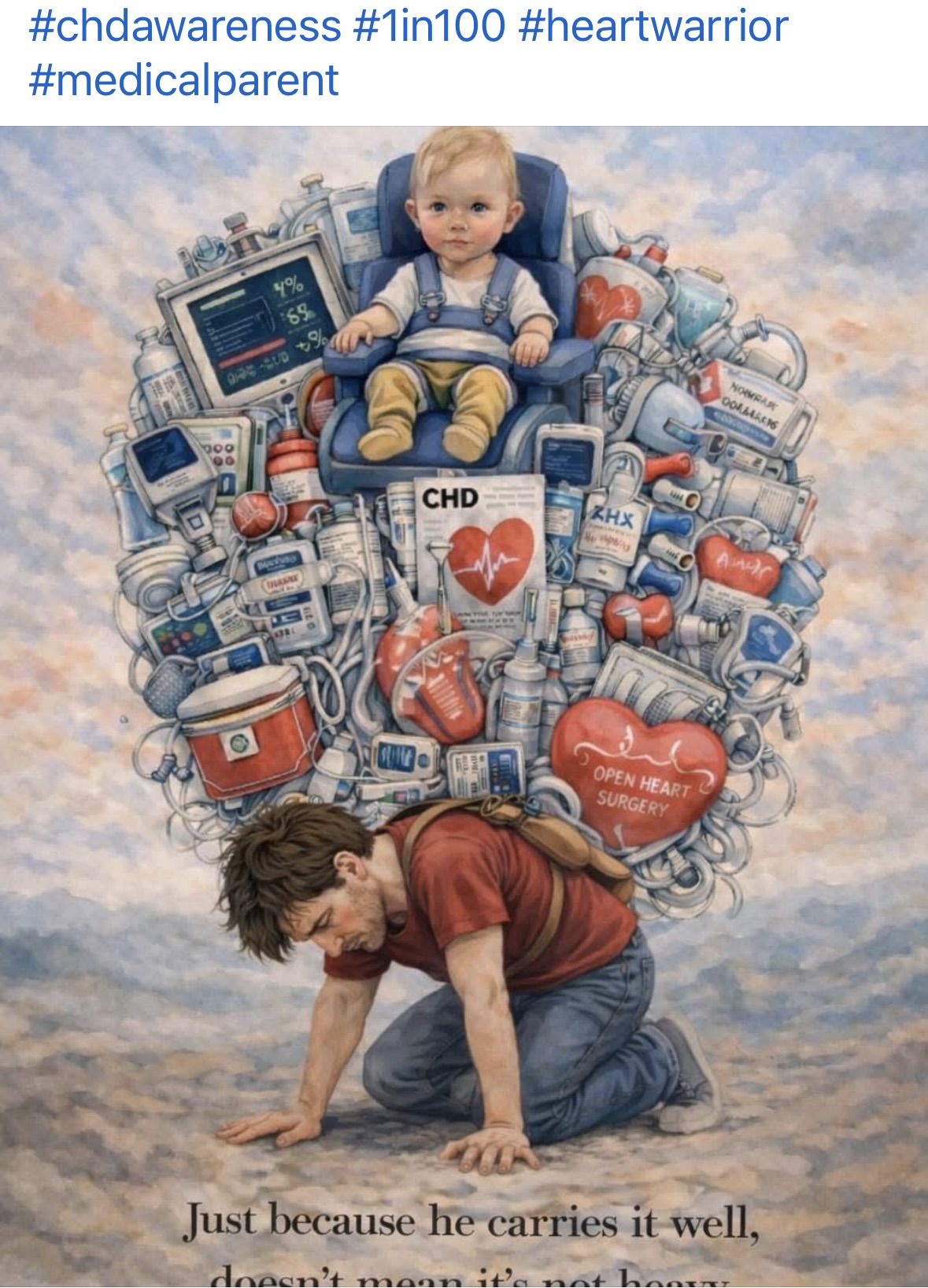
Many of the recent AI-generated “awareness” images circulating online depict parents crushed under the weight of CHD. They show caregiving as collapse, exhaustion, and spectacle. Even when shared with good intentions, they carry a powerful implied message for the child at the center of the story.

You are the weight.
You are the cost.

That message sticks.

I know this because I have lived it. When I was a child, my father once joked that I was “more trouble than I was worth.” He did not intend harm. It was meant facetiously, a throwaway comment. But it landed squarely on one of my greatest fears. I internalized it, and I have been unpacking the impact of those words in my life, including in therapy, for the last 30 years.

Children with heart disease already worry about how much they ask of the people who love them. They already carry guilt that is not theirs. Vacations cancelled. Trips cut short. Bills expanding. Time off work dwindling. Over the years, through my time with kids at heart camp, I have seen this weight show up again and again. Children worrying about being too much. About causing stress. About being the reason someone else is tired, overwhelmed, or afraid.

This is why these images matter.

I have created CHD-related graphics myself in the past. I believe there is a meaningful difference between imagery that centers care, advocacy, and love, and imagery that turns the child into the source of suffering. Framing matters. Symbolism matters. What we choose to emphasize shapes how children understand themselves.

Content that frames illness as something a parent endures because of a child does not raise awareness for that child. It quietly teaches them that their existence is what broke someone else, often the very person they turn to for comfort and care. A parent should be standing beside their child in the fight, not cast as someone crushed by them. A child’s heart condition is part of who they are, but it is not all of them, and it should never be treated as the most important part, even when it demands the most attention.

This kind of framing does not stop with images. It shows up in the language we use, too. Do not even get me started on the label “heart warrior.” I understand why people reach for it, and there are times it IS empowering. It is meant to honor resilience however, timing and situation are key. But for many of us, it carries an unspoken pressure to be brave at all times, to endure without complaint, and to make our suffering palatable to others. When you are called a warrior, fear starts to feel like failure. Grief feels like weakness. Needing rest, softness, or support can feel like letting people down. Children absorb that too. They learn quickly that being loved is tied to being strong, even when they are exhausted, scared, or in pain.

All of this is why these conversations feel so fraught, especially when they happen in public. We are not just reacting to a single image or a single word. We are responding to years of messaging that asks children to carry guilt quietly and to perform strength and bravery convincingly.

When I tried to engage with the person who created these images, my response was not as constructive as it could have been. I was reacting from a place of hurt, and I wanted to give some of that hurt back. It was not my best moment. At the same time, my lived experience was dismissed rather than heard. That dismissal is something many people with chronic illness or disability encounter repeatedly.

We are often asked for our insight or guidance, only to have our reality rejected because it is uncomfortable. Because it does not allow others to pretend nothing is or can go wrong. Or because it requires seeing a child as a whole person who needs many kinds of care, not just care for their disease.

Honoring parents and acknowledging how hard caregiving can be does not require turning children into symbols of burden, martyrdom, or collapse. I truly believe that parents of sick children are incredible. They do carry a great deal of weight, and they deserve to be honored and supported. But not because they are surviving their child. Because they are fighting alongside them. Because they know how to make the moments better, even when they cannot fix the illness.

I want these parents to be proud of what they do. I am deeply proud of my own mother and everything she has faced with me. That is exactly why images like these hurt.

There are other ways to tell this story. Picture yourself not as someone crushed under the weight of your child’s illness, but as someone standing beside them, clearing a path. A parent whose coffee fuels vigilance and care. Whose notebook of symptoms and questions is not evidence of collapse, but a tool of advocacy. Not a martyr, not a survivor of their child, but a partner in the fight.

I believe most people share images like these with good intentions. I am simply asking that as CHD Awareness Month approaches, we also consider their impact, especially on the children who grow up absorbing these messages long before they have the words to question them. Their feelings and well-being deserve to remain at the center of our advocacy.