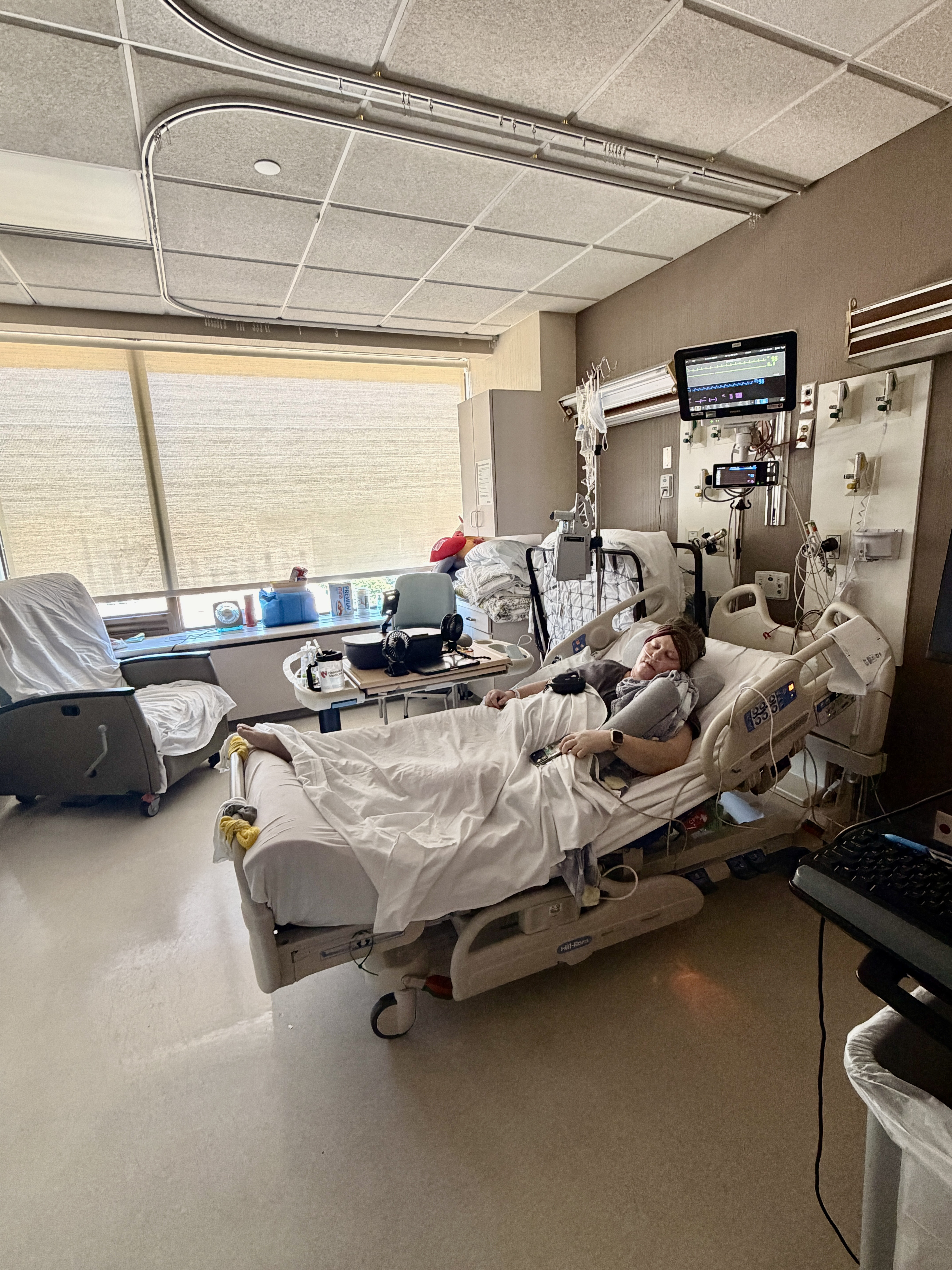
Twenty days later…
It’s been 20 days since the wildest 24 hours of my life.
Twenty days ago, at 10:04 p.m., the nurse coordinator on duty started calling with a heart offer—and I continued to sleep. She called my family, who also began calling me, and still, I slept. I had taken a sleep aid and was really out to the world.
My oldest sister called the police for a wellness check. My second-oldest sister started pinging all of my devices using the “Find My” feature on her phone (we share a plan). That little trick worked, and at 10:14 p.m., my sister was the one to let me know my life was about to change forever.
Everything since that moment has been a bit of a blur. Be it the absolute adrenaline rush, the meds, or the monotony of days spent in the hospital, it feels like I have been here forever and no time at all.
Rachel, my oldest sister, left two days ago after spending the days prior with me, staying each night on what may be the worst cot in the world.
My mom remains and will continue to care for me in the following weeks. She comes each day to feed me, snooze with me, and entertain me the best she can. We’ll stay at a hotel in Omaha for a couple more weeks after my release while I attend appointments, have labs drawn, and, in general, am kept under a close eye to see how I’m doing.
My first biopsy, two weeks ago, showed level 2 cellular rejection. It was still present after my second biopsy last Monday.
The word “rejection” is, admittedly, a terrifying word to hear when someone has just given you their heart. My nephew for one, would really like them to pick a different adjective. But rejection after transplant does not necessarily mean what it sounds like. My immune system is doing exactly what it was designed to do: recognizing something that wasn’t originally mine and trying to attack it. The anti-rejection medications are there to convince my immune system to stand down, so we will adjust those for best effect.
Cellular rejection is something transplant teams watch very closely for, especially early on. Level 2 is concerning enough that it needs to be treated and monitored, but it is not unheard of, nor does it mean that my new heart is failing or that the transplant has failed. It means my doctors have some work to do getting my immune system and my new heart to peacefully coexist.
I’ll have another biopsy this Tuesday to see how things are responding. My surgeon, Dr. Um, believes the rejection is likely already under control, but that the last biopsy was simply a little too early to show it. We shall see if he is as smart as we all believe him to be. He is optimistic that the next biopsy will show what he expects—and that I can finally leave these four walls before the coming weekend.
I am hopeful, but cautious.
In general, I am doing okay. I have moments when I am frustrated and discouraged. In those moments, I do my best to name the feeling and say it out loud: “I am frustrated.” “This is frustrating.”
It helps keep me from catastrophizing. Things WILL get better, but in this moment, I am frustrated—and that is okay. Even miracles can be frustrating. It doesn’t mean they are any less miraculous.
I do make a real effort to take moments to connect to this heart, to welcome it to my life and body, to connect with it in ways missing nerves prevent.
There have also been moments when I have completely lost it. Moments when anger, fear, sadness, happiness, and frustration have all overcome me, and every feeling is suddenly on full display.
But if I am being truthful, I think I have mostly been numb.
I don’t think my brain is quite ready to do both things at once: heal physically while also trying to comprehend everything that has happened to me in the last 20 days. There is the surgery itself, this new heart beating inside me, the fear of rejection, the medications, the hospital, the uncertainty, the gratitude, and the enormous reality that my life has changed.
Maybe my mind will catch up with my body eventually.
For now, I think healing is enough.
Many have asked if I have had the chance to say goodbye to my heart, to see it in any way, and the answer is no. Not yet.
Before transplant, I was adamant that this was something I would absolutely need. Now, I’m not so sure.
I am going to make sure I don’t lose the opportunity. I’ll make sure someone has access to a photo so that, if I want to see it someday, I can. But right now, it feels like too much.
Just hearing my surgeon explain how incredibly sick my heart was was painful.
I am so proud of that heart.
It carried me through so much. It kept going when it had every reason not to. And after everything we went through together, I’m not sure I am ready to look it in the eye, so to speak.
At least not yet.
There is tremendous grief in that thought, and I don’t think I’m ready for that grief right now.
Maybe someday.
For now, I think it is enough to be grateful for the heart that carried me this far, while learning how to live with the one that will carry me forward.
It is surreal to think about this whole new organ chugging away in my chest. It feels so different. It feels strong. It feels like it is ready to go—just waiting for its new body to get its shit together and heal enough to show off its strength.
Turns out, a heart transplant isn’t like swapping out the AAs.
Between the new meds and the massive amount of healing there is to do, the “feeling better” part takes a while, it’s a whole system reboot and the network is a little unstable.
Tuesday morning I go for my third biopsy, and I am hopeful the results will be such that I am able to finally be released. I hope this not just for myself but for my family as well. As much as I have been through, they have been through it too. And because I truly believe that hard is hard no matter if you’re the one in the bed doing the healing or the one on the cot doing the caring, I want a clear biopsy for them just as much as I want one for myself. We all need a bit of normalcy back.
And before I end this very long update, I need to say thank you.
Thank you to my family, who have dropped everything, lost sleep, sat beside me, worried about me, advocated for me, fed me, made me laugh, and loved me through every version of myself these last 20 days.
Thank you to my sister Rachel for being the zoom arounder, and the lower to the grounder. For spending night after night on that terrible cot beside me, and for advocating for me like no one else can. For knowing when to push, when to ask the question again, and when I need someone else to be strong and loud on my behalf. All during the same week you sent our boy off to college. I promise I’ll try and time my next life-altering event a little better.
Always my sword.
And thank you to my sister Aimee, who has taken on the mind-numbing administrative side of all of this—the paperwork, phone calls, bills, and all of the little things that somehow still have to happen even when someone is busy getting a new heart. Thank you for keeping the wheels rolling and the bills paid when I haven’t had the brain space to even think about any of it. There is so much work that goes into keeping a life running, and you have quietly carried so much of that for me. And for guarding my sanity and humanity.
Always my shield.
And Mom.
I think, in some ways, we have spent 44 years training for these days.
The defect in my heart was never your fault, but I know it has always been your biggest worry and, in so many ways, your most intense mission. For 44 years you have watched, worried, learned, questioned, advocated, protected, and loved me through all of it. And now, here we are, on the other side of the thing we have spent a lifetime knowing might someday come.
I hope you know how deeply I love and admire you. Your strength. Your love. The way you advocate for me. The way you have always somehow known when I needed a friend, when I needed a nurse, when I needed a fighter, and when I just needed my mom.
I made it 44 years with that heart because it was incredibly strong. But I also made it 44 years because of the love and devotion you have shown me every single day of my life.
You helped carry that heart for 44 years, Mom.
Now we get to learn this new one together.
A special thank you to my Uncle David and Aunt Lori for making the trip to come see me. Having you here in the middle of all of this meant more than you know.
Thank you to Anette and Shalyn for keeping things together for me back home while my entire world has been happening here. Knowing that the pieces of my life I can’t tend to right now are in good hands has given me the space to focus on healing.
Thank you to my friends and to every single person who has called, texted, checked in, prayed, sent something, offered help, or simply reminded me that I am not doing this alone. I may not have had the energy to respond to everyone, but please know that I have felt your love even when I haven’t been able to acknowledge it.
Thank you to the nurses, doctors, surgeons, coordinators, therapists, techs, and everyone else who has cared for me. There are simply not enough words for the people who have made it their job to keep me alive and help me learn how to live again.
And then there is a thank you I don’t quite know how to write yet.
To my donor, and to the people who loved them: there is no combination of words big enough for what you have given me. Somewhere inside an unimaginable loss, a decision was made that gave me another chance at this life. I carry that knowledge with me alongside the gratitude, and I suspect I will spend the rest of my life learning what it means.
For now, all I know to say is thank you.
Thank you for the love. Thank you for carrying me. Thank you for this heart.
And thank you for more.
More time. More ordinary days. More chances to make plans and actually expect to be there for them. More chances to love the people I love and to be loved by them.
Just… more.
I don’t know yet what I’ll do with all of it.
But I am so incredibly grateful that I get the chance to find out.
Twenty days later, everything has changed and everything is possible.

