CHD Awareness?

Last night, while scrolling, I stumbled across a set of images about congenital heart disease. I was not looking for them. They simply appeared. And if I am really honest, they were about the last thing I needed to see after a day of watching appointment after appointment populate my hospital’s patient portal, while also grappling with the heavy emotions of transplant evaluation, again.

What surprised me most was how upsetting they were, even now, even after decades of living with congenital heart disease as an adult. I still carry a familiar tension. I need support, and I also worry deeply about asking for too much of the people who love me. Those two things have always lived side by side in my body. Seeing these images brought that conflict straight to the surface.

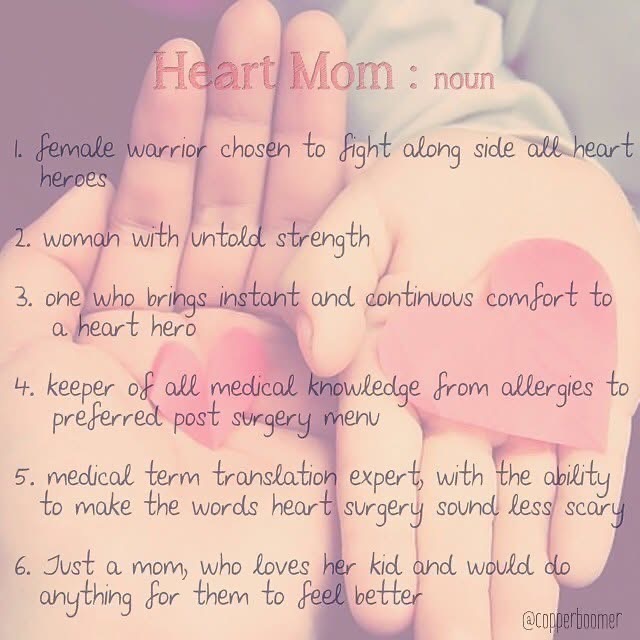
I want to be clear about why images like these are damaging, and about the difference between what a “heart mom” or “heart dad” might see, versus what a person living with CHD sees.

I am a 43-year-old adult living with congenital heart disease. I grew up as the child everyone worried about, planned around, and tried to protect. Children with CHD learn very early to read the room. We learn to track tone, tension, and fear long before we have language for what is happening inside our own bodies.

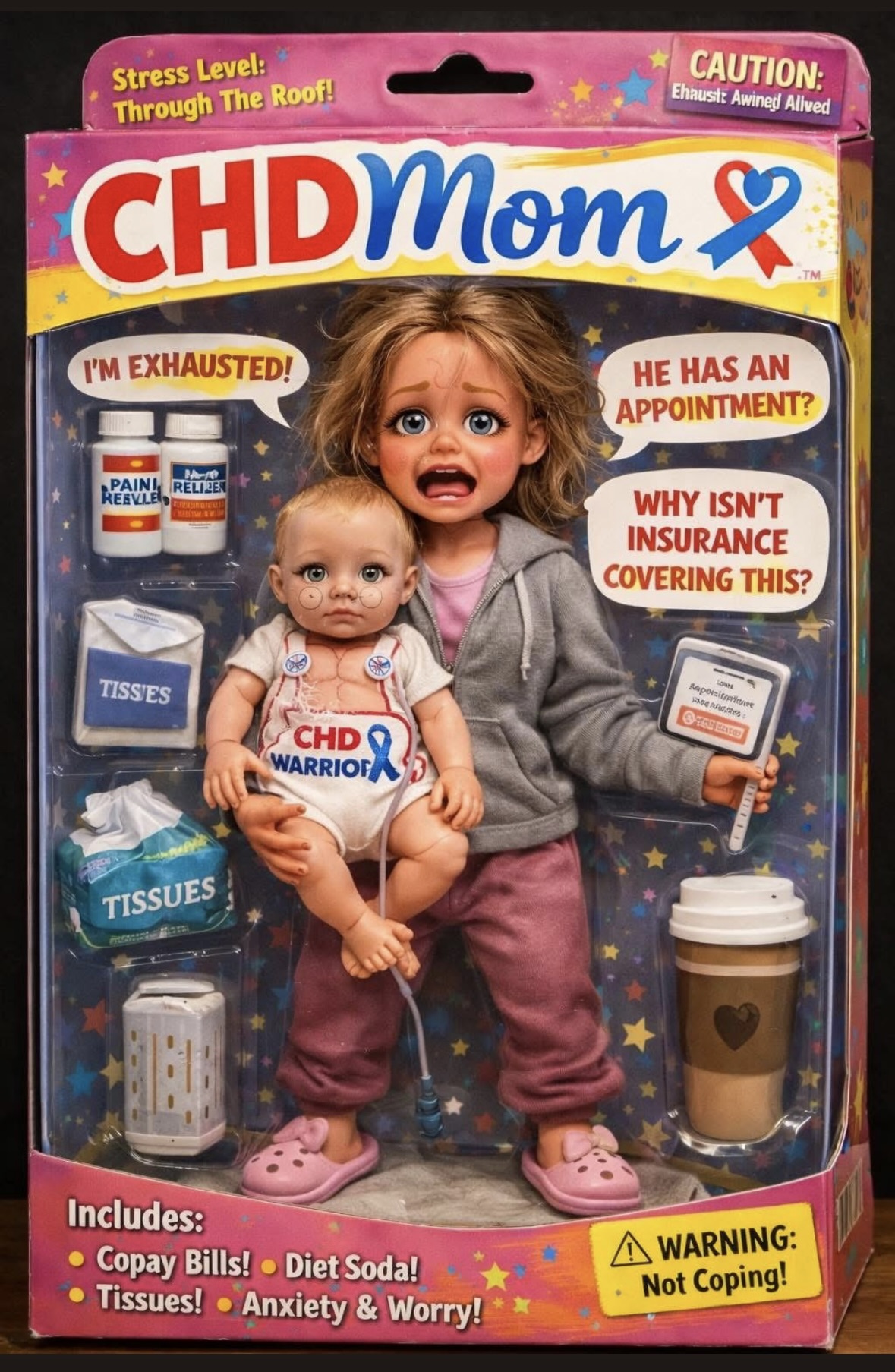
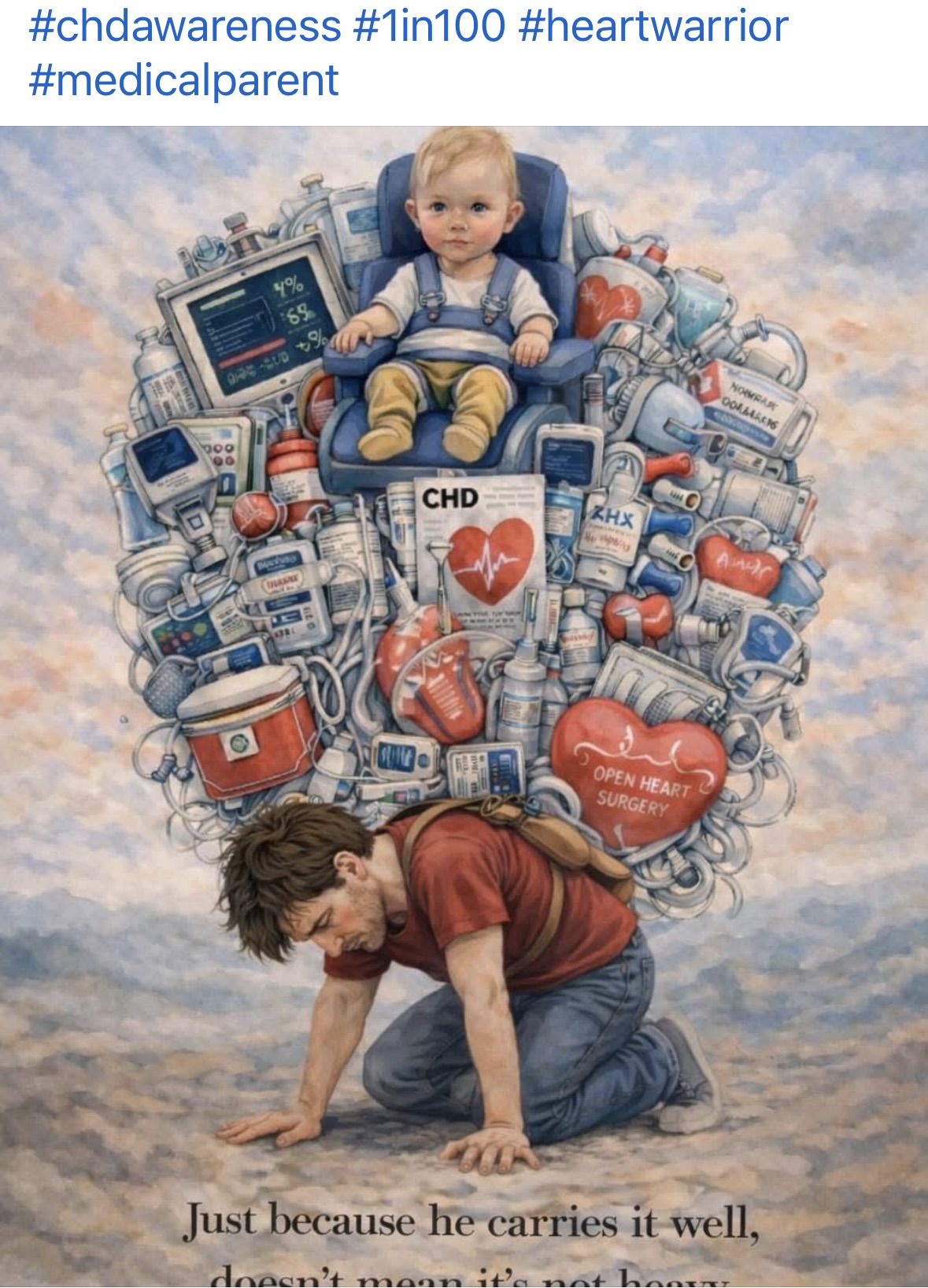
Many of the recent AI-generated “awareness” images circulating online depict parents crushed under the weight of CHD. They show caregiving as collapse, exhaustion, and spectacle. Even when shared with good intentions, they carry a powerful implied message for the child at the center of the story.

You are the weight.
You are the cost.

That message sticks.

I know this because I have lived it. When I was a child, my father once joked that I was “more trouble than I was worth.” He did not intend harm. It was meant facetiously, a throwaway comment. But it landed squarely on one of my greatest fears. I internalized it, and I have been unpacking the impact of those words in my life, including in therapy, for the last 30 years.

Children with heart disease already worry about how much they ask of the people who love them. They already carry guilt that is not theirs. Vacations cancelled. Trips cut short. Bills expanding. Time off work dwindling. Over the years, through my time with kids at heart camp, I have seen this weight show up again and again. Children worrying about being too much. About causing stress. About being the reason someone else is tired, overwhelmed, or afraid.

This is why these images matter.

I have created CHD-related graphics myself in the past. I believe there is a meaningful difference between imagery that centers care, advocacy, and love, and imagery that turns the child into the source of suffering. Framing matters. Symbolism matters. What we choose to emphasize shapes how children understand themselves.

Content that frames illness as something a parent endures because of a child does not raise awareness for that child. It quietly teaches them that their existence is what broke someone else, often the very person they turn to for comfort and care. A parent should be standing beside their child in the fight, not cast as someone crushed by them. A child’s heart condition is part of who they are, but it is not all of them, and it should never be treated as the most important part, even when it demands the most attention.

This kind of framing does not stop with images. It shows up in the language we use, too. Do not even get me started on the label “heart warrior.” I understand why people reach for it, and there are times it IS empowering. It is meant to honor resilience however, timing and situation are key. But for many of us, it carries an unspoken pressure to be brave at all times, to endure without complaint, and to make our suffering palatable to others. When you are called a warrior, fear starts to feel like failure. Grief feels like weakness. Needing rest, softness, or support can feel like letting people down. Children absorb that too. They learn quickly that being loved is tied to being strong, even when they are exhausted, scared, or in pain.

All of this is why these conversations feel so fraught, especially when they happen in public. We are not just reacting to a single image or a single word. We are responding to years of messaging that asks children to carry guilt quietly and to perform strength and bravery convincingly.

When I tried to engage with the person who created these images, my response was not as constructive as it could have been. I was reacting from a place of hurt, and I wanted to give some of that hurt back. It was not my best moment. At the same time, my lived experience was dismissed rather than heard. That dismissal is something many people with chronic illness or disability encounter repeatedly.

We are often asked for our insight or guidance, only to have our reality rejected because it is uncomfortable. Because it does not allow others to pretend nothing is or can go wrong. Or because it requires seeing a child as a whole person who needs many kinds of care, not just care for their disease.

Honoring parents and acknowledging how hard caregiving can be does not require turning children into symbols of burden, martyrdom, or collapse. I truly believe that parents of sick children are incredible. They do carry a great deal of weight, and they deserve to be honored and supported. But not because they are surviving their child. Because they are fighting alongside them. Because they know how to make the moments better, even when they cannot fix the illness.

I want these parents to be proud of what they do. I am deeply proud of my own mother and everything she has faced with me. That is exactly why images like these hurt.

There are other ways to tell this story. Picture yourself not as someone crushed under the weight of your child’s illness, but as someone standing beside them, clearing a path. A parent whose coffee fuels vigilance and care. Whose notebook of symptoms and questions is not evidence of collapse, but a tool of advocacy. Not a martyr, not a survivor of their child, but a partner in the fight.

I believe most people share images like these with good intentions. I am simply asking that as CHD Awareness Month approaches, we also consider their impact, especially on the children who grow up absorbing these messages long before they have the words to question them. Their feelings and well-being deserve to remain at the center of our advocacy.

Not An If…

On the drive home from my most recent doctor appointment, I didn’t feel dramatic or panicked. I felt quiet. The kind of quiet that settles in when something has shifted but hasn’t fully announced itself yet. I drove, followed familiar roads, and let the conversation replay in my head. This time, when he said the word transplant, it wasn’t like the first time. It is weird to have become accustomed to those words, that idea, over the last couple of years. The first time, it felt like all the air had left the room, like the floor and ceiling had suddenly flip-flopped, and I was listening from 10 feet underwater, words muffled, unable to breathe. This time it was different. When I looked at my sister and she at me, our eyes met in that quiet place between hope and acceptance. We wanted different, hoped for different, but knew the score and that I’ve been living in over-time for a while and perhaps I’ve shot my last hail Mary to save this game.

That night, at home in my own bed, sleep came and went. I think I saw each hour of the night, some for a moment, some for an hour or more. My body was exhausted, but my mind kept circling the same thoughts, not urgently, just persistently. Somewhere between waking and dozing, I realized I was no longer thinking only about what had been said in that room, but about everything that had led me there. The routines I’d built. The changes I’d made. The story I’d been telling myself about why they mattered and what they could achieve.

It was in that space, between the drive home and the restless night that followed, that something became clear.

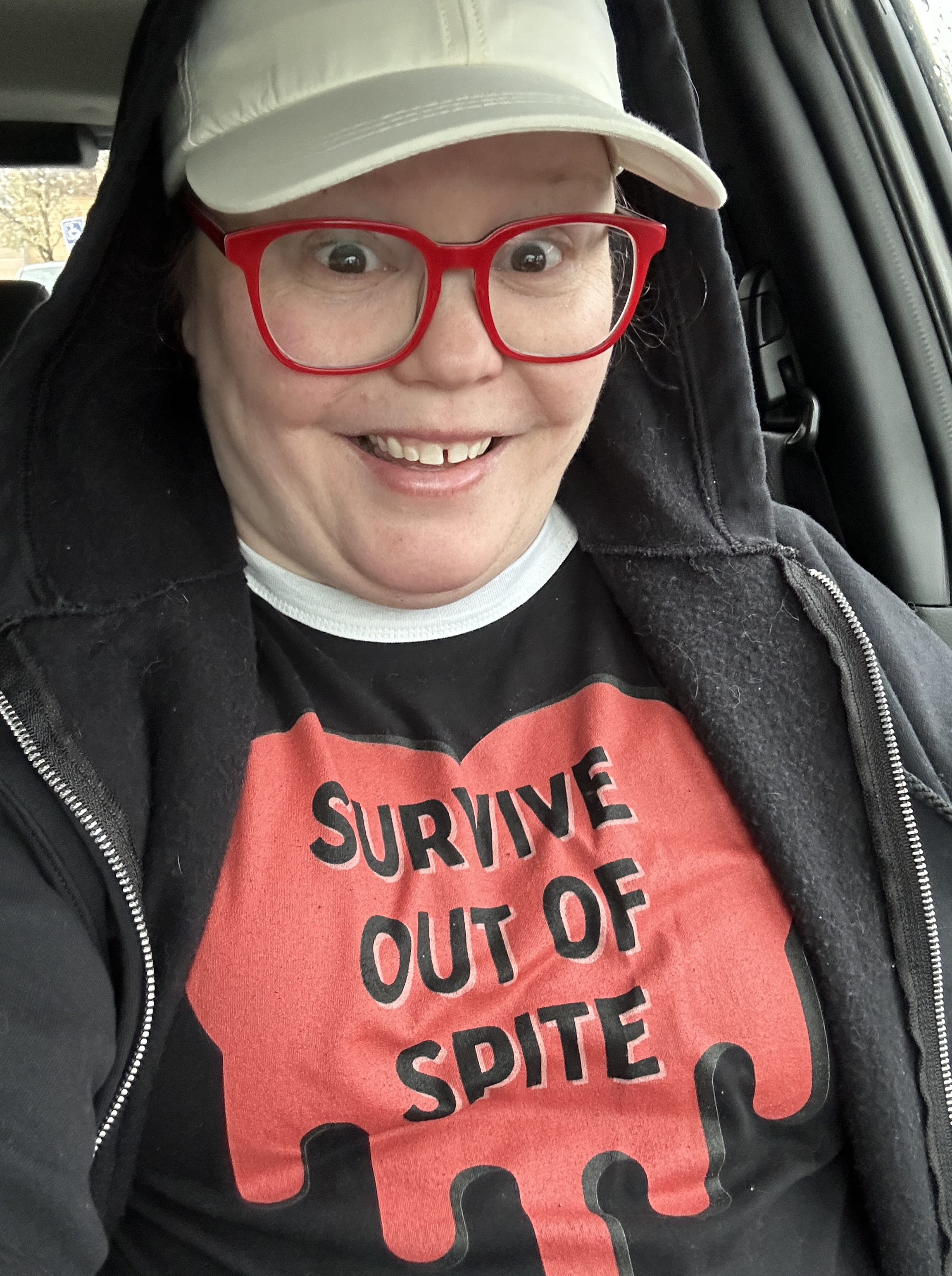
I think part of me forgot why I started working out, taking Zepbound, and eating healthier in the first place. The last time my case was presented to the transplant panel, I was overweight and for that reason, much like Shark Tank they were out, and I was not considered a good candidate.

Somewhere along the way, maybe because I am stubborn, or because I have a deeply ingrained “watch me” attitude, I convinced myself these changes were proof. Proof that despite what “they” said, I could exercise my way out of a heart transplant. I took it as a challenge, a double dog dare to do the thing that no one else had done before, as if no one else had thought of it. Now, thinking of those words, I hear understanding and empathy. They weren’t challenging me. They were letting me know that getting healthier is always a benefit, but the goal should be to manage, not cure. They were trying to let me off the hook, and I just put myself right back on.

I tend to hear statements like that as challenges. It is how I hear most things people tell me I cannot do. My brain hears “can’t,” and my soul says, “wanna bet?” I will beg, borrow, and steal to turn the can’t into a can, the won’t into a will, the don’t into a done.

But it turns out they are right. I cannot exercise my way out of this. And instead of that realization feeling like defeat, it feels like permission. Not permission to give up, but permission to take the pressure off myself. Permission to take a breath and know that while I can do everything in my power to improve the outcome, some things simply are. Transplant isn’t an if, it is a when, and that when may be closer than I had hoped.

Letting go of that pressure does not mean I stop caring for my body. It does not mean the workouts were pointless or the changes meaningless. They still matter. They matter because they help me feel stronger, because they give me better days, because they make living in this body a little more comfortable and a little more mine.

What has shifted is the reason behind them. I can no longer chase an outcome I cannot control. I need to stop treating my body like a problem to be solved or a test I must pass to earn worthiness. I have to care for it because it is the only one I have, and because it is already doing the best it can.

There is grief in this realization. Grief for the version of the story where effort alone could fix everything. Grief for the illusion that if I just tried harder, pushed more, proved enough, I could outrun what has always been part of me. Letting go of that story is a bit painful, but I know it is necessary. It is also a relief. Relief in no longer measuring every good choice against an impossible finish line. Relief in knowing that my job is not to defeat my heart, but to live alongside it. To support it where I can, to listen when it asks for rest, and to stop demanding that it be something other than what it is.

The last couple of days, I’ve noticed an internal tug-of-war. Part of me wants to prepare everything, simplify everything, get my ducks in neat little rows. Another part of me wants to lie down more, to rest in a way that feels almost instinctual, like a bear knowing it is time to hibernate. At the same time, I want to keep moving my body, eating well, and investing in the future I still very much hope for. On the other hand, I want comfort. Small treats. Familiar shows. Soft things. (No matter how much I talk about wanting a cat, I cannot have one. Not in a box. Not with a fox. Now is not the time, and while I may whine about it, I also know it is true.)

None of these urges cancel each other out, even though they feel contradictory. They are just different ways my body and brain are trying to keep me steady in a season that is anything but.

These last few days, overwhelm and numbness seem to compete for control, and neither quite wins. What’s left is a quiet middle space. Not peaceful exactly, but contained. A kind of emotional low-power mode. I am learning that this does not mean I am avoiding what is happening or failing to process it. It means I am holding things carefully, taking them in doses I can manage.

Thinking about transplant is strange, and my feelings about it fluctuate wildly. It is complex and deeply emotional, filled with hope and terror in equal measure. The idea of how I might feel once a new heart beats in my chest is exciting, and it opens the door to images of a life I never thought possible.

I picture myself on mountain trails. I imagine morning jogs with a golden retriever (Did I borrow it? Did I steal him? Is he mine and I finally pulled the trigger on a dog named Tom Hanks?). I am doing those things purely for fun, because I am told, they can be fun when it doesn’t feel like fighting for your life. I see myself going, and doing, and being someone different, (somehow taller?), freer, less constrained by the quiet calculations and constant double-checking that shape my days now.

And then my thoughts shift to the reality of getting there. All the pieces that have to fall into place. The process of being listed, ranked, and waiting. The logistics, the uncertainty, the surrender to timelines that are not mine to control.

Then there is saying goodbye to the part of me that has shaped me into who I am, the only rhythm I have ever known. That part that I have been angry at, indebted to, bargained with, fought for, fought with, wired and medicated, all so we could blow out one more set of candles together. And of course there is the hardest part, I think, for anyone needing this particular kind of transplant, knowing that for me to receive a new heart, someone else must no longer need theirs. That truth sits heavy and unavoidable. It mixes hope with grief, excitement with reverence. It is the part that reminds me this is not a miracle without cost, but a gift born from unimaginable loss, a loss I have known, a loss I have witnessed, a loss that often feels like too high a price for someone who has squeezed 43 years out of a life they said might not even last a year.

Right now, I am holding all of this at once. Hope and fear. Gratitude and grief. Determination and exhaustion. Some moments I feel steady and grounded, and others I feel raw, distracted, or not quite like myself. None of it is performative, and none of it is permanent. It is just where I am.

If I seem different, quieter, sharper, or more emotional than usual, I hope there can be patience for that. I am learning how to live inside uncertainty without hardening myself against it. I am doing my best to show up honestly, even when that honesty looks uneven.

I still believe in forward motion. I still believe in caring for my body, in finding moments of joy, in imagining a future worth hoping for. I am simply learning that hope does not have to be loud or singular to be real. I don’t have to play the part of optimistic sick person for people to enjoy my company. Sometimes it is complicated, sometimes it is fragile, and sometimes it is just the choice to keep going, one day at a time.

Listen to Your Body

For as long as I can remember, people have told me to listen to my body. It was practically the soundtrack of my childhood. I heard it from nurses, from my mother, and most recently from my cardiologist, who said it with the same energy as someone offering ancient, mystical wisdom. Going to a high elevation? “Listen to your body.”

It sounds gentle and intuitive. It sounds like something you’d hear during yoga while someone rings a tiny bell. But for me, that phrase has never meant serenity. Listening to my body has always meant one thing: prepare for impact.

My body has never been a calm inner compass. It has been a 24-hour breaking news alert system. “This just in, you might be dying…” Numbers. Readings. Symptoms. Side effects. Every twinge a possible emergency. Every flutter a potential disaster film in the making. .

“Is this a headache or a stroke?”
“Chest pain or arthritis?”
“Am I tired or am I fatigued?”

And my personal favorite: “Do I have a blood clot?” A diagnosis I have never had in my entire life, but a theory my brain presents with the enthusiasm of a kid showing you their newest treasure.

After years of this, listening stopped meaning awareness. It became surveillance. It was less “inner peace” and more “airport security.” And thanks to the alphabet soup of C-PTSD, OCD, ADHD, and other neurological party tricks, that vigilance was cranked up to maximum volume.

To be fair, I was born with a complex heart condition, so paying attention mattered. Small shifts really did mean something. But somewhere along the way, I began to believe my literal survival depended on catching every flicker of sensation before it turned into catastrophe. My body became a project, and I became a project manager who never got a day off.

Eventually, something rewired itself. I stopped recognizing my body as a place where emotions lived. Sensations were never just sensations. They meant illness or medication changes or tests or occasionally “Hey, for real though, you might be dying.” A racing heart was not fear. Tightness in my chest was not sadness. My body wasn’t allowed to feel; it was only allowed to signal.

Even professionals played into this without meaning to. A dull ache? More tests. A weird flutter? More medication. A moment of discomfort? Let’s throw in a scan for fun. No one, including me, considered that my body might also be speaking in the language of emotion.

By the time panic attacks appeared, I’d spent years responding to every sensation as if it belonged to my heart. So when the symptoms started, the doctors and I followed the same script we always had; tests, scans, monitoring. It wasn’t until we ran out of physical explanations that we finally realized: my body wasn’t warning me about my heart. It was trying to tell me I had feelings I’d never dealt with, and my mind was tired of waiting it’s turn.

Now, when I try to feel my feelings, I often get static. What I hear is the echo of a system that kept me alive but no longer matches the life I’m trying to live. Any detachment I experience is not apathy. It is survival being a little overzealous and not knowing it can clock out now.

Even the most basic emotions can hit the old alarms. I rarely assume I am having a feeling. I assume I am having an event. The smallest beep from a microwave or phone still makes my brain behave like it is back in the hospital, ready for a plot twist. It is very Lost in Space. My mind goes full B9 yelling, “Danger, Will Robinson,” and my system responds as trained: shut it down, stay calm, stay alive.

These days, I am trying to listen differently. I am learning to notice the quieter signals: the warmth of a blanket, the gentle rhythm of breathing, the moment of contentment when a room feels safe. I am teaching my body that not every sensation is a threat and not every feeling requires medical intervention. Some things can simply exist without becoming a diagnostic mystery.

People love to tell those of us with lifelong medical conditions to be strong. But strength does not always look like vigilance. Sometimes strength looks like unclenching your jaw, and relaxing your shoulders. Sometimes it looks like rest. Sometimes it is trusting that your body can communicate without sending up a flare. A whisper can be just as wise as a wail.

I am not trying to unlearn survival. Survival has been my longest relationship. I am simply trying to expand it, to let it include moments of ease and belonging and maybe the occasional emotion without the immediate assumption that the end is near.

So when something rises in my chest now, I pause. I breathe. Take a quick look at my vitals, just to satisfy the tiny intern who lives in my brain. (I am still me guys.) But when everything comes back normal, I remind myself that a feeling can simply be a feeling. A heartbeat can simply be a heartbeat. And sometimes the noises I once treated as danger are nothing more than the ordinary soundtrack of being alive.

Maybe this is the real meaning of listening to my body. Not scanning for illness, but noticing the quiet whisper of an emotion before I mistake it for something medical. Not bracing for danger, but letting myself recognize sadness, or joy, or fear, or grief as themselves. I spent most of my life believing feelings were symptoms. Now I am learning how to tell the difference, and even more than that, how to let emotional feelings exist without rushing to diagnose them. It turns out my body has been trying to speak in many languages, and I am finally learning to understand more than one.

Tightrope. (You don’t look sick…)

Every day, I walk an invisible tightrope. Step by step, I inch forward, steadying myself, fully aware of the drop below. Chin up. Smile. Do not let the audience see the tremor in my hands or the heaviness in my bones. They expect composure, strength, even grace in this precarious balancing act.

So I play my part. One foot, then the other. Smile for the crowd. Hide the weariness. The rope wobbles, but the performance must remain steady. The crowd applauds, but they never see the fatigue, the fear, the longing for solid ground.

Like a Flying Wallenda, I never auditioned for this life; I was born into it. With no other choice, I have mastered the theater of survival, the art of balance, and the silence of exhaustion hidden behind a smile. The rope stretches on, longer and farther than I ever imagined, and though there are days I ache to step down, still I walk. Because the show, it seems, must go on.

The show is my daily life. Over the years, I have learned that nobody likes a sad sack, and people can only tolerate one for so long. But in truth, I am not sad. That part is not an act. Sure, there are days when I do not feel well and must paste on a smile, but even then, I carry joy. I love the life I have built within the confines of my circumstances, and most days, even the hard ones, I am happy.

Still, the act causes confusion. Because I do not “look sick,” “act sick,” or often show the cracks in my armor, people struggle to reconcile the visible with the invisible. Now that I have added workouts as part of my healthcare, it baffles some even more, and I understand why. It is hard to grasp that while I can lift weights or walk a mile, I cannot work an eight-hour day. My tank does not hold that much fuel. Heart failure has diminished my capacity, so I must ration what I have. Doctors’ orders.

Every morning, I wake up and prioritize. At the very top, above all else, is my heart. Keeping it as strong as it can be is not a luxury, it’s an imperative. It is the rope itself. Without it, there is no performance. And I am not ready to say I want a new rope, so it must come first. Because of that I’ve had to drop other things, like 2.5 hours of my work day. I just don’t have the fuel to do it all, and trying makes me so sick that I can’t do any of it. 

I cannot help what others understand or do not. I refuse to wallow in self-pity or bend myself into the narrow mold of what a “sick person” should look like or act like. Even doctors have been baffled, studying test results that scream decline, then looking at me, upright and smiling, and wondering how someone who on paper must feel miserable is not a cranky, bitter mess. And if I am honest, there are some days that I am but that is nobody’s business but mine (and my therapists). I get to present myself to the world in whatever way I choose.  I choose a life of joy, fun, determination, and optimism, even if the world around me can’t make sense of it. So, one foot, then the other, I continue forward.

This is my act. This is my balance. This is my rope. And though the crowd may never fully understand, the show is not about them. It is about me, still walking, still smiling, still here.

I can’t help it if I am cute even when I am very, very sick.

OCD. My Heart. And Me.

My heart races for two reasons: one, because it can’t always keep rhythm (damn tachycardia), and two, because my mind insists it’s about to stop. I’m open about my heart condition and my mental health, but I rarely talk about how the two gang up on me.

Today in therapy, I spent the usual 15–20 minutes circling the topic I knew I needed to address. Maybe one day I’ll get straight to the point, but not today. It’s hard to admit when OCD is in the driver’s seat. It feels like failure, like I’ve lost control. But as a previous therapist said, “What you resist persists.” So, I started talking.

First, I recapped my recent cardiac appointment and its not-so-great results. Then, I proudly announced my renewed gym plan, Monday, Wednesday, Friday mornings. Perfect. Predictable. Manageable.

Then I had to confess, last Friday I didn’t feel well, so I skipped. I promised myself I’d make it up Saturday or Sunday. Except I couldn’t. I go Monday, Wednesday, Friday not Saturday, not Sunday. If I went off-script, surely I’d injure myself, exhaust myself, maybe even ruin everything. And then, to top it off, the gym was closed this Monday for the holiday. How could I possibly go Wednesday if I hadn’t gone Monday? Clearly, the whole week was ruined. Not only is my heart failing but I am too. My heart was doomed. Why bother?

I know none of this is rational. These thoughts aren’t truly mine, they’re symptoms. Intrusive thoughts brought to you by OCD.

OCD is a master of manufacturing catastrophes out of nothing. In therapy, I can roll my eyes at the absurdity, but at home it’s harder. I can label the thoughts as silly, but acting against them is another story. Fear, even unreasonable fear, has teeth.

So my therapist and I played “What if.”

“What if you planned to go Thursday instead of Wednesday?”

Then I’d have to go Friday too, which is impossible, two days in a row? I’ll croak!

“What if you could go two days in a row?”

Then I’d be exhausted all weekend.

“What if you weren’t?”

Then it would hit me Monday and ruin the week.

Round and round we went, until finally:

“What if everything turned out okay?”

“What if you worked out three days a week…any three?”

“What if you allowed flexibility without neglect?”

That one hit home. I felt lighter. I could feel my posture change. I am stronger than OCD, I reminded myself. Then my therapist asked, “So, how does Saturday sound now?”

Stubborn as ever, I told him the truth: “I still don’t like it… but I think I could try.”

And I want to try. Because OCD doesn’t just push me to color-code my sock drawer, it can slide into dangerous territory, like keeping me from taking care of my heart. And that’s when I have to remind my brain who’s boss.

So this week I have homework, go to the gym on a day that isn’t Monday, Wednesday, or Friday…just once in the next two weeks. Doesn’t matter if it’s in place of a regular day or in addition, I just have to do it. While exposure therapy is probably the most effective treatment (in my experience) for OCD, that doesn’t make it easy. Still, I believe in doing my homework. So I will do the only thing I ask my students to do…try. You don’t have to be right, you don’t have to be perfect, just try. Here goes nothing.

Me vs. Myself

“Man vs. Self: a literary term that describes a character’s internal conflict, or the psychological battle they face within their own mind.” 

Yup, that’s me, stuck in a literary conflict in the real world. I bet you’re wondering how I got here, all tied up in knots and battling nothing but myself. Allow me to take you back dear reader, to one month ago. I was super stoked to show off my weight loss and health progress to my transplant doctor. He was super stoked at how awesome I am doing. I rode that high for a couple of weeks. Then the undercurrent of that appointment started to nag at me a bit. 

You see, during that appointment we talked about how awesome I am doing. We also discussed how much better I am feeling. We decided together to get some data to back up all of my hard-won progress. This dear reader, is when I kind-of-sort-of allowed my brain to turtle out of the conversation. I had heard what I wanted to hear. There was no need to listen to anything else or absorb it. Right then, into my metaphorical shell I went. 

There is nothing wrong with data, I personally love data. It’s hard to argue with data. Data shows me that what I am feelings is real. I haven’t just convinced myself and others that I’m fine. But am I fine? That is where the test comes into play, and that is why in that moment, into my shell I went. 

One month from today I will repeat the dreaded VO2 max test. I will put on the scuba mask and hop on a stationary bike. I hope to prove to my doctor and myself that I have succeeded. That I have done what they told me I couldn’t. I exercised my way out of needing a transplant. 

My VO2 max has been around 12 for about 3 years. According to my transplant doctor, this is the lowest they like to let people get before listing them. My team first started gathering this data with transplant in mind in 2021. During that year, I did poorly. We called it a scratch because I had just spent the last year inside my house and was “de-conditioned”. In 2022, I did the test again. Once again, I stunk up the room. It was at this appointment we called 12 my baseline and started talking about transplant. 2023, rolled around and the test was kind of the put up or shut up test. If I did not do any better than 2022, then I probably wasn’t just de-conditioned in 2021 but instead have advanced heart failure and we needed to start talking seriously about transplant. Can you guess how I did in 2023? That is right friends. I actually did the worst of the three tests so far. Things were not looking so hot for our hero. That kicked off transplant testing. As we all know from following this story so closely and never forgetting anything, the first time my case was presented to the transplant board, I was denied. In general I was still too healthy to list. This was actually good news. Eight months later, I struggled to work a full day. I was sick pretty much all the time. My case was presented to the board again. Once again, I was denied. They largely considered me too large, my weight was a problem. They did not think I would be a good candidate. They also doubted I could get a good enough heart at that weight. (There is a whole size equation that comes in to play, I’ve explained it before, I can’t want to explain it again.)

It was after that major disappointment that I begged to try something, anything to feel better. The answers were, work fewer hours, and start cardiac rehab. Check and check. I have to admit I was dubious about these solutions. I had been told word for word “you can’t exercise your way out of this.” Looking back I can see this statement was really traumatic for me. In the moment it was just a bit of a gut punch but now, it rings in my head daily in the way that only the most terrible things can. 

So, in March of this year three months after being denied for listing, I started cardiac rehab, and wouldn’t you know it…I started getting stronger. I also started a weight loss program, with help from both calorie restriction and a weight loss drug. Here I am seven months later. I’m inching towards 40 pounds down and feeling better than I have in years. I’m still working out three times a week. My muscles are coming out of retirement. In 30 days time, I will repeat the test that has bested me for the last four years. 

Here’s the rub, and the sentence that caused me to turtle out in my mind at that appointment. If my test is better, that is awesome. It is proof that my hard work paid off. We can delay transplant. If the test is the same, or worse, we have to talk about transplant again. This time my weight isn’t going to exclude me. To be fair that was the goal of cardiac rehab and the weight loss medication. The goal was not to slim me down for vanity’s sake. It wasn’t to get me swole. It wasn’t so I could live happily ever after with no worries of transplant. The goal was to slim me down, get me healthy enough that I could crush a transplant and come out the other side. The goal was to put me in a position where the hearts that I would be offered, were hearts that could go the distance with me. Along the way I found myself leaning into a new goal, delaying transplant, and doing what they said I could not do, exercise my way out of heart failure.

So that’s where I am right now, that is the internal battle I am fighting. I know what the original goal was, but along the way I found a new one. I feel like I am going to crush the VO2 max. My stamina is better than it has been in a very long time. However, data and feelings are two different things. Data talks louder than words. There is a chance that my VO2 max is still 12. There is a chance that when those results come in, we will be once again, having a serious talk about transplant.

I can’t lie. I will be crushed if that is the case. I have worked so hard. Not improving would devastate me. I am “training” really hard at the moment, specifically for the test. My workout at the gym is mainly on the kind of bike I will be tested on. I have to say, it is kind of kicking my butt. I can’t go longer than eight minutes right now. My heart rate gets too high, so I have to pull back. I worry I have tricked myself. I might think I am doing better because I haven’t actually been challenging myself much. It is me against myself right now. I am using all of my therapy tools but sometimes we just have to feel our feelings good, bad, or ugly.

 I have a dream of hitting 20 for my VO2 max, if I hit 20 I have told myself I can get a new cat. I haven’t allowed myself to even think about a new pet since Gus. I knew that if the transplant went forward, it wouldn’t be fair for the animal. A VO2 max of 20 would give me an 8 point buffer between me and transplant. Hopefully, I would be able to maintain it and put off the transplant for at least another 10 years. My doctor also hopes for this outcome.

My reasonable goal for my VO2 max is 15. This goal tickles me for a number of reasons but the biggest one is, that is still lower than the “poor” portion of the VO2 max scale. It isn’t even near hitting “poor” in fact, I’d have to hit 25, to be considered in the “poor” category. Isn’t that funny? It is so true what they say about being grateful for what you have because what you have even if it is not much, could be someone else’s wildest dream. 

I know one thing for sure. No matter what happens with the test this time around, I can honestly say that I have left it all on the field. I have done everything asked of me over the last seven months. If the test isn’t good, there is nothing left to do. I have thrown all I have at avoiding transplant. I have done all I can to make myself stronger. I have actively participated in my care. I have committed to my overall health and wellness. If I don’t improve, it is because something far out of my hands is wrong and I have to accept the next steps. See, just typing all this out has helped, guess writing really is a good tool for me and my mental health. I am not hand writing, however it is still working, guess the ol’ therapist and I will have to agree to disagree on that one.

As always, thanks for hanging out in my brain for a while. I know there is a lot of junk in here, but I hope sharing it with you all leads to a bit of understanding, a bit of reflection, and maybe even some hope? I will update you in a month (unless I get the urge before). In the meantime, cross your fingers. Sprinkle pixie dust, do a naked moon dance, or even pray. Hope that whatever is meant to be on this journey of mine comes to be. I hope to find peace with whatever it is. Thanks. 

Vaguely Nauseated and Kicking Ass

Next week, on September 18th, I will have been vaguely nauseated and kicking ass for six months. Vaguely nauseated? Yes. Zepbound, the weight loss, heart failure, diabetes prevention, fatty liver resolving, ADHD improving, OCD quieting medication I am on, is not all sunshine and weight loss. I spend about 3-4 days after my shot each week vaguely nauseous. Most of the time it is just a nagging unease in my stomach, but especially on weeks my dose is increased, it can make me so nauseated I become sick. It is absolutely still worth it, did you see all those things that studies are finding it improves? And I have all those things! 

This week I went to my transplant team in Omaha and saw my doctor for the first time in  six months. My last appointment was with his PA, so he has not had the pleasure of my company since the Zepbound and all of my efforts started. I say this with absolutely no irony, homeboy was darn near giddy with my improvement. My BMI has gone down significantly and is now within acceptability range for transplant. If you remember back to the end of December last year, I said this “If there is anything I have learned through this whole process it is that I shouldn’t bury the lede, so here it is, after being presented for a second time, my case for heart transplant remains on hold and I have not been listed…This is actually good news in its way, this means that I am stable and strong, and I can keep going without a transplant. Once again my weight plays a large factor in this decision, and I am again not angry about that, though I am a bit annoyed I didn’t have a shot at my new medication for a while before my case was presented.”

A more accurate representation of what that meant isn’t that I was stable and strong, it was that I was stable and too fat to get a heart that would be worth trading mine for.  It meant the heart I have currently is plenty strong if my choices of new hearts were going to be old and not particularly strong themselves. As much as blood type and antibodies come into play with transplant, so does size. If you are a 250 pound person you can only accept a heart within 10 pounds of your weight. If that weight is 250, the problem becomes anyone that is within that weight and not 6’2’ + is in the morbidly obese category themselves and not a great candidate to donate. If they are 6’2” or more the heart will likely be too big for my chest, even if it is a healthy heart. It is a whole Cinderella and the slipper situation. At the time I was relieved I was denied again, I truly want to keep this heart as long as I can, but I was also ticked off that I was not able to get the medication I needed to lose weight in time for it to affect the outcome of that particular transplant tribunal (everybody wants to win right, and nobody wants to be told they are chonky). 

Now, I have had that medication for 6 months. I have also been going to the gym three times a week for those 6 months, I have been watching every calorie going into my body for those 6 months, which means that I have lost the weight that was needed in order to be better qualified for transplant. To be ideal for transplant, I have another 50 pounds to go (this is not MY goal weight, if I get there great but I am not going to go nuts trying to achieve this weight, my goal is 20 more pounds). The thing is, I am feeling better. Apparently, people who eat right and exercise feel better? Seems fake, but okay. I have not cured my heart failure, but the blood test that indicates heart failure while not resolved is the lowest it has been in 5 years. Now my days don’t feel like punishment for living anymore – I was truly struggling before, and now while I am not the picture of health, I have a lot of my normal activity back. All of this to say I’ve unsheathed a double edged sword. 

In November I will have my VO2 Max test again. I have been below the cut off for transplant consideration in that test the last three times I have done it. An average person’s score is somewhere between 50-60. Mine is barely 13, and has been for some time. If I flunk again in November my doctor will now be able to put me forward for transplant and I will likely be approved. If that test doesn’t improve there will be no reason not to list me. 

Isn’t that good news?

It is. But it also isn’t…

I thought you wanted a new heart? I sure did.

And in ways I still do, but now that I understand the process more, I want that to be as far in the future as possible. My doctor said it in my last appointment, if I only want to be transplanted once in my life, then it would be great to wait as long as possible and be as healthy as possible in the meantime. If I am super honest I would love to ride into the sunset with the heart I came with but I also want to be around to see what kind of shenanigans my nephews get up to as adults, so it isn’t likely that this ticker is going out with the rest of me. I am not saying I should have stayed overweight to avoid transplant. I am saying, being overweight took it off the table. I am hoping that now I am healthier, I can put it near the back of the table, or over on the counter even. Anywhere not right in front of or on my plate. 

All of this comes down to that test I have in November. I don’t get to fail it again. I will pass or be put forward again. My goal is to get a 15, two points of buffer between me and that dreaded 13. My sky is the limit goal? 23. Ten glorious points away from the list. Proof that maybe I can exercise my way out of this after all or I can get nice and lean and otherwise healthy so my choices of hearts are better, and my recovery smoother. Until then, it is the gym for me. It is 1500 calories a day and 1800 on weekends. It is taking my meds and doing all I can to stay as healthy as I can. It is participating in my care so no one can say I didn’t try as hard as I could. Are you still with me? My cheerleaders have been my saving grace this whole time. Your support means so much to me, and motivates me to keep going. Thank you for being here. 

Until next time. 

Rehab Week 3

As my third full week of cardiac rehab is coming to a close, I wanted to take a moment to reflect on my experience in that time. There are changes happening for sure, but not all of them are ones that I expected. When I started rehab, I expected to get stronger, increase my stamina, and maybe (hopefully) lose some weight. I didn’t expect my mental health to improve, my family to join me in my quest for better health, or if I am honest, to be very successful. I was hopeful when I started rehab but it felt similar to hoping there would be a pony under the Christmas tree. I might have really wanted it, but I doubted I would really get it. I am so glad to have been wrong. 

A big part of cardiac rehab, and a part that I was pretty sure I was going to stink at, was getting my diet under control. There are a few things where diet is concerned that I am excellent at, for example, I am really, really good at watching my sodium intake. It is a rare day that I go over my allotted 2000mg and if I do it isn’t by much. Edema fears my sodium tracking skills. What I am not (or wasn’t) good at, is tracking calories, fat, carbs, anything delicious. My thought has always been a bitter one, “If I have to give up salt, I am not giving up anything else.” and I would add unsalted butter, and eat sugary snacks with reckless abandon. I knew when I signed up for rehab that this attitude would have to change, if I was going to give this opportunity the best chance to make me feel better it couldn’t just be three days of exercise a week. Which is why, 25 days ago I started using an app called Lost It! I feel like they should start paying me because I sing its praises to anyone who will listen. I have religiously recorded every food that passes my lips, and I am happy to report that out of 25 days, my calories have been under budget every single day!

Reasons I love the Lose It! App:

  • Losing weight is gamified in a way I personally enjoy, for example each day I log all my meals, it contributes to my streak. I currently have a streak of 25 days and I will be really sad if I mess up my streak before day 100. 
  • You can buy a subscription for life. Instead of paying $50 bucks a year, you can pay $120 bucks and have the app for life. When you are making a lifestyle change, this option helps solidify that decision. I am not just doing this for the year I am subscribed, this is forever. Perhaps it is just the way my brain works but that distinction makes a difference. 
  • They have a TON of verified food options, be it fast food or products. Verification means the nutrition information that they have comes straight from the horse’s mouth. 
  • I am constantly earning little rewards or encouragement. It tells me when they see a healthy pattern such as, I have lower calories for the day when I eat eggs for breakfast. It also tells me how much weight I have lost as compared to household objects (I have lost a desk lamp or 5 pounds) and of course keeps track of my logging streak. 
  • My sister is using the same app and we can share our progress, recipes etc. 

Speaking of my sister, talk about something unexpected that has come from rehab! I am incredibly lucky and thankful to have my big sister join me both in eating better and adding exercise to her routine. It is awesome to go on this quest for wellness (I am sorry I really hate calling it a journey, a journey makes it sound like I am going on a nice trip. A quest, I think, leaves room for overcoming challenges and doing hard things.) together. We check-in, motivate and complain to each other. It has been nice to not feel like I am the only one going through this shift in the way I live my day to day.  It is not my place to talk about her business on the internet but it is pretty safe to say that most people could benefit from a shift to a healthier lifestyle. It is very motivating to know that we are in this together and that she wants to be healthy enough to hang out with me (and her kids I guess)  for a long time after I get a new heart. 

Another thing I didn’t expect but am greatly enjoying is a newfound sense of determination. I think sometimes when living a life that has a lot of limits, those limits start to encroach on parts of your life where you aren’t truly limited. I think there comes a point that you are so used to limits that you impose them in places that they don’t naturally exist. Feeling my edges so to speak has really given me confidence to push myself a bit harder in places that I hadn’t been. Instead of being a lump when I get home, I can spend 20 minutes cleaning the kitchen, or the evening doing laundry. My days don’t HAVE TO end at 3 p.m. I find myself waking up in the morning feeling energized and excited to get to rehab or my solo home workout. I think the best way to describe it is, it feels a little like I am sticking my tongue out and blowing a raspberry in the air, and saying “You can’t catch me!” to my own heart failure. I also think there isn’t a small part of me that is annoyed that I have thus far been unable to get the weight loss medication I have been prescribed due to shortages and misunderstandings. I feel a bit like Thanos saying “Fine, I’ll do it myself” to the system that is keeping me from receiving that particular weight loss jump start. 

Perhaps it is because of the new determination, paired with the feeling of safety that rehab offers that I feel that my efforts at the gym and in my diet have been successful. I am a person who regularly starts and stops this kind of quest. When the going gets tough, I get going…home. Go big or go home? Awesome, I’m headed home. I think I have reached the perfect blend of spite, safety, and determination to be successful. My workouts have quickly increased in length and effort over the last 3 weeks, I am going farther, longer, and faster each day. I feel stronger, physically and mentally. I am exhausted, but because of effort not because my heart is sluggish and my mood is poor. 

I am excited that I have 11 more weeks to keep getting stronger, and learning more about what I really can do. Hopefully in that time my muscles will figure out that this isn’t going to stop happening, and will calm down about how hard I am working them. In fact, the muscle aches are pretty much the only thing I can say that is negative about any of this. Does anyone have any hot tips about muscle recovery? My arms and legs are noodles for the whole night after a hard workout. Is that just what happens when you work out hard? Am I doing something wrong?  Do I just need a massage? Are my arms and legs secretly noodles and it is only apparent when I try to work out with them? Any help is appreciated. Thanks as always for cheering me on. You guys are awesome and it is really nice to hear from you all, and have your support. In addition to everything else, it is very impactful to know that I have such an awesome cheering section.

Rehab Day 1

They tried to make me go to rehab and I said, “Hell yes! Finally.” Not exactly as catchy as Amy Winehouse but sometimes the truth isn’t catchy. Today, I completed intake for 36 sessions, 14 weeks, of cardiac rehab and I could not be more thrilled. Over the last few months I have tried working out on my own only to run up against the same issue, time and time again. I just get scared. I know to you heart-healthy people that is an odd issue to have, but there comes a point where I don’t know if I am pushing myself or pushing my luck. When that happens I find myself giving up, too scared to keep going. That is why when I saw my doctor last month I asked if I could do more cardiac rehab, and he approved. I knew I would be rolling the dice with insurance whether they would approve it for me or not, and was prepared to only have 6 sessions if they did. Getting 36? A full course? I am so excited. It feels like I finally won a battle after a long, long losing streak. 

There are so many benefits of cardiac rehab for me that go beyond just the customized workout. For one thing, the scheduled appointments assure I will actually attend. It is far too easy for my brain to talk me out of going to the gym, there is no accountability, and I can justify just about any reason to skip. Conversely, I don’t miss appointments, I am the person who is early to everything. The structure of these sessions will be great for my ADHD brain. They will also give me a safe place to feel for my edges, to learn better what my body feels like when I am entering the danger zone, and when I am just pushing. Learning this will hopefully help me when working out on my own, to have the confidence to continue. 

Things I love about cardiac rehab: 

  1. Old men exercising in jeans. I would say 90% of the people in cardiac rehab are men over the age of 60 (heart attacks likely), and of those men 90% wear jeans to work out. It cracks me up. 
  1. I am a unicorn to them. These nurses are used to working with the aforementioned old men in jeans with acquired heart disease and a tendency to push back about all the lifestyle changes they are being asked to make. Not me, this has been my life for 41 years. They aren’t asking anything of me that hasn’t been asked before. Plus, both this time and last the nurses remarked about enjoying learning about my heart, and seemed very amused by me in general. I love being amusing, and I am happy to provide a little break from the old dudes. 
  1. Sonic ice! I love it. Who doesn’t love Sonic ice, that they can access for free? 
  1. Constant feedback on my heart while working out. Blood pressures, BPM, pulse ox, they check it all, and tailor my work out to what my body tells them. 
  1. Help from an honest to goodness nutritionist on tailoring my diet to better serve me. I do a good job with this but guidance and feedback are so nice. 
  1. This is a medication free way of regaining some of my lost heart function and I am all for anything that doesn’t require another pill. 

I start my first real workout tomorrow and am so excited to begin. If you see me, please ask me how it is going, or shoot me a message. I need all the encouragement I can get, exercise has long been something I feared and gave up easily on. The more positive reinforcement I can get the better!  In fact, one of my questions on my intake paperwork today was about my support system. It wanted to know if I had anyone I could call if I needed support. I didn’t have to think about that question at all, and marked that I had MANY people who I could call if I needed. I truly believe that has always been my magic feather so to speak, and lets me keep flying. Thank you for that. 

Chasing the Carrot

I kind of lost it today. It has been a long, arduous month and I guess I only had exactly 31 days of patience in me. The beginning of the year is always a fun time for me (really any of your chronically ill friends, check on us, we are not okay). What is super fun about it is that, when insurance deductibles start over nothing is automatic. If you aren’t paying close attention there is a good chance things you’ve had on auto-pilot for the last 11 months have just completely broken. No warnings are given, if you are not proactive, you will not find out until you don’t have the medication you need, and trying to fix it from that point is like a clueless politician trying to help after a hurricane, paper towels are nice but my house is a fish tank.  

I have about six medications that have co-pay coupons, all of which have to be individually reapplied to their respective medications taking the co-pays down from $300-$600 (on $1200-$8000 meds) to $10, if you are thinking to yourself, that’s not right, you are correct and perhaps you’d like to vote for people in favor of Universal Healthcare. Somehow, each year no one knows how to get at least one of these coupons applied, this year it was two. In addition to that, one medication needed a prior authorization, and another a physician approval for refill. All told I have probably been on the phone with my pharmacy for three, maybe four hours in the last two weeks conservatively. 

Yesterday, I spent an hour on the phone with my insurance. All for a medication that I only knew was in danger of not being delivered because I looked, not because I was warned by anyone, or any system. The pharmacy has already sent my med packets without it. I have been working on this for TWO WEEKS and I missed the cutoff to have it included in my shipment. Now I am in danger of not having it suddenly for the first time in 5 years (I run out officially in 6 days). The things it says can happen if you stop taking it suddenly, are not great. Which may explain the franticness of my calls. After back and forth with the pharmacy, with my doctor, and with my insurance (for over an hour remember) today I was told this medication not only was denied, but not eligible for appeal or exception. I spent an hour talking to an insurance representative yesterday! She went through my policy with a fine tooth comb, and she told me, all I needed was the pre-authorization from my doctor. My doctor sends it, and within an hour it is denied. You can’t tell me that the representative didn’t know that this medication was going to be denied based on the new formulary my insurance has. I don’t blame her for my formulary, I don’t blame her for the fact this isn’t covered, that is above her pay grade. I am mad that there is no way she did not see after looking through all the things that we looked through yesterday the REASON this medication was suddenly being denied even though I had a current pre authorization on file and instead of telling me that it was denied, she said to ask for a new pre-authorization.   

This medication has been keeping my head from exploding off my body for the last 5 years, but I guess now I get to either have completely debilitating migraines again (as opposed to the only mostly debilitating ones I have now) or try a different form of the medication that my doctor already was pretty sure would not work for what I needed it to do. I am SO limited on the kinds of medications I can take, and this is just devastating. I hate that people who aren’t doctors can decide what I am allowed to have. I can’t even get it without the insurance because it is too expensive. I have a $10 co-pay card but those only work if the medication goes through insurance first. If I wanted to pay for this medication out of pocket it would be somewhere in the neighborhood of $8000 a month. Yes really. Again, the system is super broken and perhaps we could vote in ways that make this less easy for the medical complex to do? 

That is just one medication. I still have one medication that had its coupon applied and disaster averted in time for my monthly shipment. Yay! But, I know not to get too excited because the likelihood that it will apply automatically next month without me calling and having it applied manually is about 1000 to 1. The final medication has been refilled by my doctor but the pharmacy seems to think that it was canceled by him. I. GIVE. UP.  I am going to give them a week to figure this out, I am not in danger of not having it until my March shipment. I am hoping that somehow this problem works itself out but I foresee another half hour on the phone getting it fixed. It would be easy to blame the pharmacy, but this has been an issue at almost every pharmacy I have used. 

In addition to all of this, I have been prescribed Wegovy to help me lose weight in preparation for transplant. Do you think the pharmacy can get its hands on any? Do you think my insurance will cover any other type for any reason other than being diabetic? Sure won’t. Am I a literal tenth of a point from being diabetic and kind of hoping my pancreas craps out so I have a chance at getting this medication so I can get a heart? Disgustingly, yes. That is what it has come to, it would be beneficial to me to be diabetic. Insurance does not want to help us prevent things, it wants to help us march ever closer to the grave and play chicken with our plot. 

In the midst of all of this I am feeling pretty gross. Truly not well, mentally, nor physically. I am not super certain why but I have a feeling heart failure is a big part of it. On top of that it feels like I am doing everything I can to put off transplant, get the medication and services I need, literally fight people for what I need to live and every time I get close, the carrot is moved just a little further away. Guys, I am starting to think you can’t get the carrot. It’s really hard to stay motivated to “get better” when it is already so hard. Don’t admit that though, you don’t want anyone to think you don’t WANT a transplant or don’t WANT to get better. Don’t let anyone think you might not be compliant. I want it more than anything, I spend all my time TRYING to comply, but the bureaucracy is crushing, the roadblocks are everywhere, and I just want the damn carrot already.