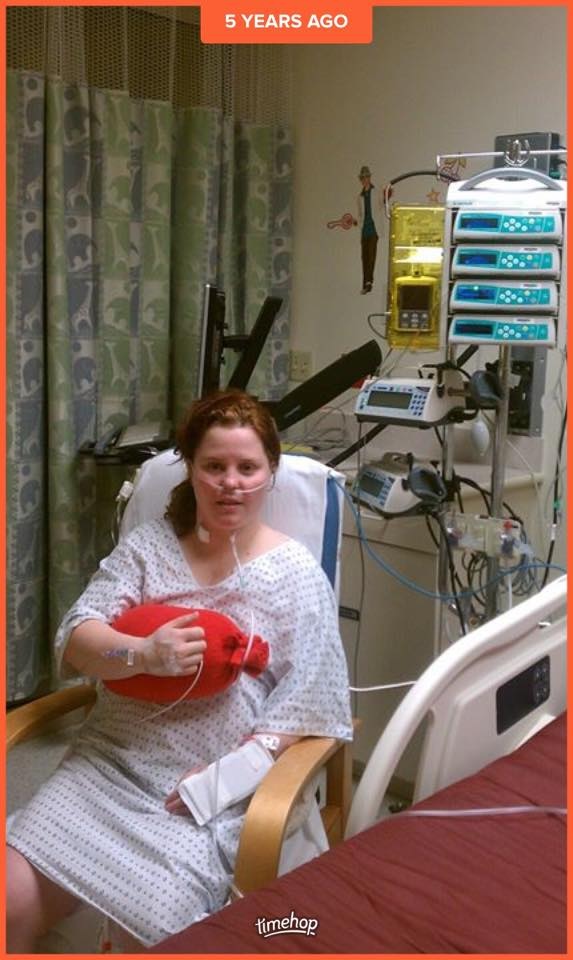
Letting Go

As my evaluation dates grow closer, I keep thinking about being sick enough, and whether I even know what that means. Medically, it isn’t my choice whether I’m sick enough; that decision is above my pay grade. It is however, my choice whether I feel sick enough to agree to being listed, and to accept everything that comes with that.

This has been a very hard thing for me my whole life.

When you live within the paradigm of a person with a chronic illness, or a progressive disease, whatever you want to call it, your definition of feeling healthy is often leagues apart from the average person’s definition of feeling well. That discrepancy has reared its head more than once in my life, much to the confusion of people who live within the paradigm of health and wellness.

Imagine my surprise when, at 13, I discovered that most people don’t experience sudden racing heartbeats that make them feel ill. Or the time I found out that it isn’t, in fact, normal to wake up from a dead sleep gasping for air, or feeling like someone just punched you in the center of your chest. Whoops.

How was I supposed to know? I’d never known anything different. And the doctors weren’t asking those specific questions, so I wasn’t answering them.

“How are you feeling?”
“Fine.”
“Are you having any heart issues?”
“No.”
“Have you had any issues with dizziness or fainting?”
“No and no.”

They never asked, “Are you waking up gasping for air?” or “Do you feel sick to your stomach after exertion?” So I assumed that was A-okay. Upon reflection that was probably a giant dose of disassociation/denial but I have enough to unpack in therapy already so, moving on.

I wasn’t stupid. I understood that the other kids could play in PE class much longer than I could, but I could still play. And because our PE teacher was a bit of a taskmaster with no time for whiners, I often pushed myself beyond what I felt my limits were, just to avoid being singled out by her.

But it’s not like my friends and I sat on the swings at recess and debriefed about how we felt after gym class. There wasn’t really anywhere for a kid, especially one who’s always been pretty literal, to gain context for what I was feeling.

And in a lot of ways, that’s still true.

Am I sick enough?

Is the life I have right now so hard, and so distant from where I want to be, that it’s worth pushing all my chips in and hoping to come out the big winner?

If I am sick enough, what does that mean about me and about the “little heart that could” that still beats in my chest? The heart I’ve been betting on my entire life to defy the odds and prove people wrong. And what about the life that I have made purely out of spite and determination? What happens to all that stuff if I give up now? Is it giving up, or is it moving up?

In therapy I’ve talked a lot about the way I personify my literal heart as a character in my life; both friend and adversary, hero and villain.

What does it mean if I agree to exchange it for one of those fancy, normal hearts? A heart that hasn’t known what it is to struggle for each bit of oxygen it provides. A heart with no scars, no history, no quirks.

What part of me do I lose when I lose it?

I’ve talked about this exact thing so much in fact, that my therapist has suggested he could write a letter to the transplant team explaining why he thinks I would benefit from seeing my old heart once it is out of my chest. He knows how important this relationship (and it is a relationship), is to me and thinks it might be best to allow me a moment to say a true and final goodbye. I tend to agree. It feels a lot like I will have to redefine who I am without this other part of me that shaped me and my life in so many innumerable ways.

Then again, Dr. B talks about “the window” all the time at my appointments, wanting to list me while I’m in the window. That Goldilocks zone between sick enough to need a transplant, but not so sick that I can’t endure it. I trust him. I trust his team. Why is it so hard to trust the process?

I don’t want to miss my best chance. I’ve had a front row seat to watching someone I love make the stubborn choice, the wrong choice, every single time they were offered a choice and killing themselves in the process. I refuse to be that way. I have been a fighter my whole life.

Plus, there are still so many things I would like to be around for in the future. So many things I haven’t done, or seen, or experienced. I don’t want to get to a place where the choice is out of my hands, or worse, where there is no longer a choice at all because I missed that window.

My whole life has been a lesson in endurance, physically and mentally. Every day has been a test of how far I could go, pushing boundaries, pushing limits.

Agreeing to a transplant isn’t endurance. It’s acceptance.

It’s saying, “Okay. I’m willing to put the cudgels down and stop fighting this fight. I’m ready to embrace whatever comes next.”

That’s a big pill to swallow, and I know a thing or two about swallowing big pills.

Maybe agreeing to a transplant isn’t betraying my heart. Maybe it’s the last thing my stubborn little Franken-heart and I will do together, one final act of defiance against the disease that has been trying to end this story for decades.

I don’t know.

I truly don’t.

This is where I’m supposed to wrap things up neatly in a little bow and tell you that I’ve found my resolve one way or the other. But this isn’t that kind of story. The choices are too big, the consequences too permanent, and the questions too complicated to tie up that cleanly.

Right now, I’m still sitting with the question.

Am I sick enough?

Maybe the truth is that I won’t ever feel like I am. When your baseline has always been “make the best of it” and “push through,” the idea of being sick enough for something this enormous feels almost impossible to measure from the inside. Enough implies a limit, and limits are not something I have ever been very good at accepting.

I do know this: I don’t want the choice to disappear because I waited too long. I don’t want the window to close while I’m still standing here trying to decide whether I’m brave enough to walk through it.

So for now, I’m doing the only thing I know how to do. I’m showing up. I’m asking the questions. I’m listening to the people who know more than I do. I’m putting my trust in the people who deserve it, and I’m taking each step as it comes.

Or at least I’m aspiring to do. In reality, I’m already worrying about several steps down the line. I need you to work with me here; I’m trying to keep us all optimistic.

And, in the middle of all that trust, hope and aspiration, I’m trying to figure out what my stubborn little heart and I are going to do next.

Perhaps, the bravest thing we have left to do together is let go.

Not An If…

On the drive home from my most recent doctor appointment, I didn’t feel dramatic or panicked. I felt quiet. The kind of quiet that settles in when something has shifted but hasn’t fully announced itself yet. I drove, followed familiar roads, and let the conversation replay in my head. This time, when he said the word transplant, it wasn’t like the first time. It is weird to have become accustomed to those words, that idea, over the last couple of years. The first time, it felt like all the air had left the room, like the floor and ceiling had suddenly flip-flopped, and I was listening from 10 feet underwater, words muffled, unable to breathe. This time it was different. When I looked at my sister and she at me, our eyes met in that quiet place between hope and acceptance. We wanted different, hoped for different, but knew the score and that I’ve been living in over-time for a while and perhaps I’ve shot my last hail Mary to save this game.

That night, at home in my own bed, sleep came and went. I think I saw each hour of the night, some for a moment, some for an hour or more. My body was exhausted, but my mind kept circling the same thoughts, not urgently, just persistently. Somewhere between waking and dozing, I realized I was no longer thinking only about what had been said in that room, but about everything that had led me there. The routines I’d built. The changes I’d made. The story I’d been telling myself about why they mattered and what they could achieve.

It was in that space, between the drive home and the restless night that followed, that something became clear.

I think part of me forgot why I started working out, taking Zepbound, and eating healthier in the first place. The last time my case was presented to the transplant panel, I was overweight and for that reason, much like Shark Tank they were out, and I was not considered a good candidate.

Somewhere along the way, maybe because I am stubborn, or because I have a deeply ingrained “watch me” attitude, I convinced myself these changes were proof. Proof that despite what “they” said, I could exercise my way out of a heart transplant. I took it as a challenge, a double dog dare to do the thing that no one else had done before, as if no one else had thought of it. Now, thinking of those words, I hear understanding and empathy. They weren’t challenging me. They were letting me know that getting healthier is always a benefit, but the goal should be to manage, not cure. They were trying to let me off the hook, and I just put myself right back on.

I tend to hear statements like that as challenges. It is how I hear most things people tell me I cannot do. My brain hears “can’t,” and my soul says, “wanna bet?” I will beg, borrow, and steal to turn the can’t into a can, the won’t into a will, the don’t into a done.

But it turns out they are right. I cannot exercise my way out of this. And instead of that realization feeling like defeat, it feels like permission. Not permission to give up, but permission to take the pressure off myself. Permission to take a breath and know that while I can do everything in my power to improve the outcome, some things simply are. Transplant isn’t an if, it is a when, and that when may be closer than I had hoped.

Letting go of that pressure does not mean I stop caring for my body. It does not mean the workouts were pointless or the changes meaningless. They still matter. They matter because they help me feel stronger, because they give me better days, because they make living in this body a little more comfortable and a little more mine.

What has shifted is the reason behind them. I can no longer chase an outcome I cannot control. I need to stop treating my body like a problem to be solved or a test I must pass to earn worthiness. I have to care for it because it is the only one I have, and because it is already doing the best it can.

There is grief in this realization. Grief for the version of the story where effort alone could fix everything. Grief for the illusion that if I just tried harder, pushed more, proved enough, I could outrun what has always been part of me. Letting go of that story is a bit painful, but I know it is necessary. It is also a relief. Relief in no longer measuring every good choice against an impossible finish line. Relief in knowing that my job is not to defeat my heart, but to live alongside it. To support it where I can, to listen when it asks for rest, and to stop demanding that it be something other than what it is.

The last couple of days, I’ve noticed an internal tug-of-war. Part of me wants to prepare everything, simplify everything, get my ducks in neat little rows. Another part of me wants to lie down more, to rest in a way that feels almost instinctual, like a bear knowing it is time to hibernate. At the same time, I want to keep moving my body, eating well, and investing in the future I still very much hope for. On the other hand, I want comfort. Small treats. Familiar shows. Soft things. (No matter how much I talk about wanting a cat, I cannot have one. Not in a box. Not with a fox. Now is not the time, and while I may whine about it, I also know it is true.)

None of these urges cancel each other out, even though they feel contradictory. They are just different ways my body and brain are trying to keep me steady in a season that is anything but.

These last few days, overwhelm and numbness seem to compete for control, and neither quite wins. What’s left is a quiet middle space. Not peaceful exactly, but contained. A kind of emotional low-power mode. I am learning that this does not mean I am avoiding what is happening or failing to process it. It means I am holding things carefully, taking them in doses I can manage.

Thinking about transplant is strange, and my feelings about it fluctuate wildly. It is complex and deeply emotional, filled with hope and terror in equal measure. The idea of how I might feel once a new heart beats in my chest is exciting, and it opens the door to images of a life I never thought possible.

I picture myself on mountain trails. I imagine morning jogs with a golden retriever (Did I borrow it? Did I steal him? Is he mine and I finally pulled the trigger on a dog named Tom Hanks?). I am doing those things purely for fun, because I am told, they can be fun when it doesn’t feel like fighting for your life. I see myself going, and doing, and being someone different, (somehow taller?), freer, less constrained by the quiet calculations and constant double-checking that shape my days now.

And then my thoughts shift to the reality of getting there. All the pieces that have to fall into place. The process of being listed, ranked, and waiting. The logistics, the uncertainty, the surrender to timelines that are not mine to control.

Then there is saying goodbye to the part of me that has shaped me into who I am, the only rhythm I have ever known. That part that I have been angry at, indebted to, bargained with, fought for, fought with, wired and medicated, all so we could blow out one more set of candles together. And of course there is the hardest part, I think, for anyone needing this particular kind of transplant, knowing that for me to receive a new heart, someone else must no longer need theirs. That truth sits heavy and unavoidable. It mixes hope with grief, excitement with reverence. It is the part that reminds me this is not a miracle without cost, but a gift born from unimaginable loss, a loss I have known, a loss I have witnessed, a loss that often feels like too high a price for someone who has squeezed 43 years out of a life they said might not even last a year.

Right now, I am holding all of this at once. Hope and fear. Gratitude and grief. Determination and exhaustion. Some moments I feel steady and grounded, and others I feel raw, distracted, or not quite like myself. None of it is performative, and none of it is permanent. It is just where I am.

If I seem different, quieter, sharper, or more emotional than usual, I hope there can be patience for that. I am learning how to live inside uncertainty without hardening myself against it. I am doing my best to show up honestly, even when that honesty looks uneven.

I still believe in forward motion. I still believe in caring for my body, in finding moments of joy, in imagining a future worth hoping for. I am simply learning that hope does not have to be loud or singular to be real. I don’t have to play the part of optimistic sick person for people to enjoy my company. Sometimes it is complicated, sometimes it is fragile, and sometimes it is just the choice to keep going, one day at a time.

Tightrope. (You don’t look sick…)

Every day, I walk an invisible tightrope. Step by step, I inch forward, steadying myself, fully aware of the drop below. Chin up. Smile. Do not let the audience see the tremor in my hands or the heaviness in my bones. They expect composure, strength, even grace in this precarious balancing act.

So I play my part. One foot, then the other. Smile for the crowd. Hide the weariness. The rope wobbles, but the performance must remain steady. The crowd applauds, but they never see the fatigue, the fear, the longing for solid ground.

Like a Flying Wallenda, I never auditioned for this life; I was born into it. With no other choice, I have mastered the theater of survival, the art of balance, and the silence of exhaustion hidden behind a smile. The rope stretches on, longer and farther than I ever imagined, and though there are days I ache to step down, still I walk. Because the show, it seems, must go on.

The show is my daily life. Over the years, I have learned that nobody likes a sad sack, and people can only tolerate one for so long. But in truth, I am not sad. That part is not an act. Sure, there are days when I do not feel well and must paste on a smile, but even then, I carry joy. I love the life I have built within the confines of my circumstances, and most days, even the hard ones, I am happy.

Still, the act causes confusion. Because I do not “look sick,” “act sick,” or often show the cracks in my armor, people struggle to reconcile the visible with the invisible. Now that I have added workouts as part of my healthcare, it baffles some even more, and I understand why. It is hard to grasp that while I can lift weights or walk a mile, I cannot work an eight-hour day. My tank does not hold that much fuel. Heart failure has diminished my capacity, so I must ration what I have. Doctors’ orders.

Every morning, I wake up and prioritize. At the very top, above all else, is my heart. Keeping it as strong as it can be is not a luxury, it’s an imperative. It is the rope itself. Without it, there is no performance. And I am not ready to say I want a new rope, so it must come first. Because of that I’ve had to drop other things, like 2.5 hours of my work day. I just don’t have the fuel to do it all, and trying makes me so sick that I can’t do any of it. 

I cannot help what others understand or do not. I refuse to wallow in self-pity or bend myself into the narrow mold of what a “sick person” should look like or act like. Even doctors have been baffled, studying test results that scream decline, then looking at me, upright and smiling, and wondering how someone who on paper must feel miserable is not a cranky, bitter mess. And if I am honest, there are some days that I am but that is nobody’s business but mine (and my therapists). I get to present myself to the world in whatever way I choose.  I choose a life of joy, fun, determination, and optimism, even if the world around me can’t make sense of it. So, one foot, then the other, I continue forward.

This is my act. This is my balance. This is my rope. And though the crowd may never fully understand, the show is not about them. It is about me, still walking, still smiling, still here.

I can’t help it if I am cute even when I am very, very sick.

OCD. My Heart. And Me.

My heart races for two reasons: one, because it can’t always keep rhythm (damn tachycardia), and two, because my mind insists it’s about to stop. I’m open about my heart condition and my mental health, but I rarely talk about how the two gang up on me.

Today in therapy, I spent the usual 15–20 minutes circling the topic I knew I needed to address. Maybe one day I’ll get straight to the point, but not today. It’s hard to admit when OCD is in the driver’s seat. It feels like failure, like I’ve lost control. But as a previous therapist said, “What you resist persists.” So, I started talking.

First, I recapped my recent cardiac appointment and its not-so-great results. Then, I proudly announced my renewed gym plan, Monday, Wednesday, Friday mornings. Perfect. Predictable. Manageable.

Then I had to confess, last Friday I didn’t feel well, so I skipped. I promised myself I’d make it up Saturday or Sunday. Except I couldn’t. I go Monday, Wednesday, Friday not Saturday, not Sunday. If I went off-script, surely I’d injure myself, exhaust myself, maybe even ruin everything. And then, to top it off, the gym was closed this Monday for the holiday. How could I possibly go Wednesday if I hadn’t gone Monday? Clearly, the whole week was ruined. Not only is my heart failing but I am too. My heart was doomed. Why bother?

I know none of this is rational. These thoughts aren’t truly mine, they’re symptoms. Intrusive thoughts brought to you by OCD.

OCD is a master of manufacturing catastrophes out of nothing. In therapy, I can roll my eyes at the absurdity, but at home it’s harder. I can label the thoughts as silly, but acting against them is another story. Fear, even unreasonable fear, has teeth.

So my therapist and I played “What if.”

“What if you planned to go Thursday instead of Wednesday?”

Then I’d have to go Friday too, which is impossible, two days in a row? I’ll croak!

“What if you could go two days in a row?”

Then I’d be exhausted all weekend.

“What if you weren’t?”

Then it would hit me Monday and ruin the week.

Round and round we went, until finally:

“What if everything turned out okay?”

“What if you worked out three days a week…any three?”

“What if you allowed flexibility without neglect?”

That one hit home. I felt lighter. I could feel my posture change. I am stronger than OCD, I reminded myself. Then my therapist asked, “So, how does Saturday sound now?”

Stubborn as ever, I told him the truth: “I still don’t like it… but I think I could try.”

And I want to try. Because OCD doesn’t just push me to color-code my sock drawer, it can slide into dangerous territory, like keeping me from taking care of my heart. And that’s when I have to remind my brain who’s boss.

So this week I have homework, go to the gym on a day that isn’t Monday, Wednesday, or Friday…just once in the next two weeks. Doesn’t matter if it’s in place of a regular day or in addition, I just have to do it. While exposure therapy is probably the most effective treatment (in my experience) for OCD, that doesn’t make it easy. Still, I believe in doing my homework. So I will do the only thing I ask my students to do…try. You don’t have to be right, you don’t have to be perfect, just try. Here goes nothing.